What will you learn in Learn Data Analysis Course
-
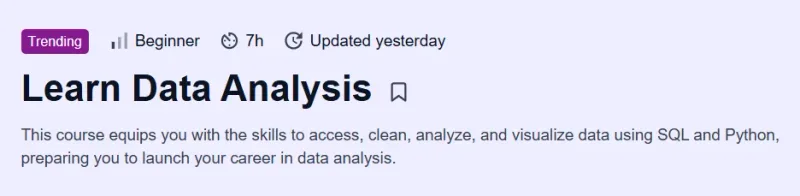
Master the data analysis workflow from raw data to actionable insights.
-
Use Python’s Pandas library for efficient data manipulation and cleaning.
-
Handle missing values, detect outliers, and perform feature engineering.
-
Create publication-quality visualizations with Matplotlib and Seaborn.
-
Apply descriptive and inferential statistics to summarize and interpret data.
Program Overview
Module 1: Introduction to Data Analysis
⏳ 1.5 hours
-
Topics: Overview of analysis lifecycle, data formats, project planning.
-
Hands-on: Outline a data analysis project and explore sample datasets.
Module 2: Python & Pandas Essentials
⏳ 2 hours
-
Topics: Series and DataFrame objects, indexing, filtering, merging.
-
Hands-on: Load CSV/Excel data into Pandas and perform basic manipulations.
Module 3: Data Cleaning & Wrangling
⏳ 3 hours
-
Topics: Handling missing data, outlier detection, type conversion, feature creation.
-
Hands-on: Clean a messy dataset and engineer new variables for analysis.
Module 4: Exploratory Data Visualization
⏳ 2.5 hours
-
Topics: Histograms, box plots, scatter plots, pair plots, and heatmaps.
-
Hands-on: Visualize distributions and relationships to uncover insights.
Module 5: Statistical Analysis
⏳ 2.5 hours
-
Topics: Descriptive statistics, correlation, hypothesis testing, confidence intervals.
-
Hands-on: Compute summary metrics and perform t-tests and chi-square tests.
Module 6: SQL for Data Analysis
⏳ 2 hours
-
Topics: SELECT statements, joins, aggregations, subqueries, window functions.
-
Hands-on: Query a sample relational database to extract and summarize data.
Module 7: Time Series Analysis
⏳ 2 hours
-
Topics: Date/time handling, rolling statistics, seasonal decomposition, simple forecasting.
-
Hands-on: Analyze sales data over time and generate trend charts.
Module 8: Dashboarding & Reporting
⏳ 2 hours
-
Topics: Designing dashboards, interactive widgets with Plotly or Streamlit basics.
-
Hands-on: Build a simple dashboard to present key metrics.
Module 9: Capstone Project
⏳ 2.5 hours
-
Topics: End-to-end project planning, execution, and presentation.
-
Hands-on: Complete a full analysis—from data ingestion to a polished report—and share results.
Get certificate
Job Outlook
-
Data analysts are in strong demand across tech, finance, healthcare, and e-commerce.
-
Roles such as Data Analyst, Business Intelligence Analyst, and Reporting Specialist typically command $70K–$100K USD.
-
Expertise in Python, Pandas, SQL, and visualization tools accelerates career growth and unlocks remote and freelance opportunities.
-
Strong analysis skills lead to paths in analytics engineering, data science, and digital reporting.
Explore More Learning Paths
Take your data analysis skills to the next level with these hand-picked programs designed to help you manage, analyze, and interpret data effectively using modern tools and techniques.
Related Courses
-
Managing Data Analysis Course – Learn how to organize, manage, and extract insights from data to make informed business decisions.
-
Data Analysis with Python Course – Apply Python programming to clean, analyze, and visualize data efficiently.
-
ChatGPT Advanced Data Analysis Course – Harness AI tools like ChatGPT to perform advanced data analysis and automate insights generation.
Related Reading
-
What Is Data Management – Understand the processes and strategies for handling data effectively to support analytics and decision-making.