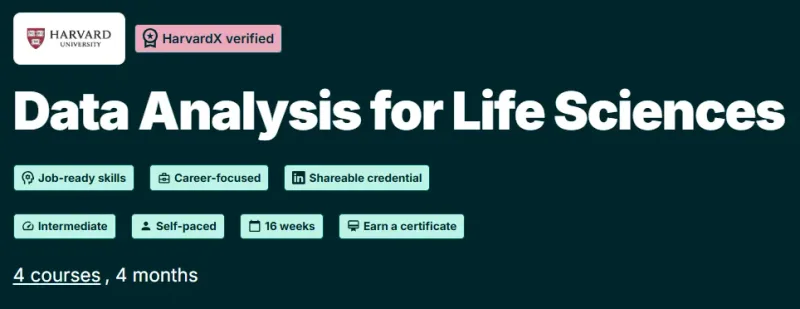
What will you learn in Data Analysis for Life Sciences course
- This Professional Certificate provides a strong foundation in statistical methods and data analysis techniques tailored for life sciences research.
- Learners will understand probability, hypothesis testing, and statistical inference in biological contexts.
- The program emphasizes R programming for data wrangling, visualization, and reproducible research.
- Students will explore experimental design, regression models, and analysis of high-throughput biological data.
- Real-world case studies from genomics and biomedical research reinforce practical application.
- By completing the certificate, participants gain analytical skills aligned with careers in biostatistics, bioinformatics, and biomedical data science.
Program Overview
Foundations of Biostatistics
⏳ 4–6 Weeks
- Understand probability and statistical reasoning.
- Learn hypothesis testing and confidence intervals.
- Explore p-values and statistical significance.
- Apply concepts to biological datasets.
R Programming for Life Sciences
⏳ 4–6 Weeks
- Learn R syntax and data structures.
- Perform data wrangling and cleaning.
- Create visualizations using ggplot2.
- Develop reproducible analysis workflows.
Regression and Experimental Design
⏳ 4–6 Weeks
- Understand linear regression models.
- Explore experimental design principles.
- Analyze controlled experiments.
- Interpret statistical results in scientific research.
Capstone and Applied Analysis
⏳ Final Weeks
- Analyze real biological datasets.
- Apply statistical models to life science questions.
- Interpret findings within scientific context.
- Demonstrate applied data science competence.
Get certificate
Job Outlook
- Data analysis skills are increasingly essential in biotechnology, pharmaceuticals, healthcare research, and public health sectors.
- Professionals trained in life sciences analytics are sought for roles such as Biostatistician, Bioinformatics Analyst, Clinical Data Analyst, and Research Data Scientist.
- Entry-level life science data professionals typically earn between $75K–$100K per year, while experienced biostatisticians and computational biologists can earn $110K–$160K+ depending on specialization and region.
- Growth in precision medicine, genomics, and health informatics continues to increase demand for data-literate scientists.
- This certificate also provides strong preparation for graduate studies in biostatistics and biomedical research.