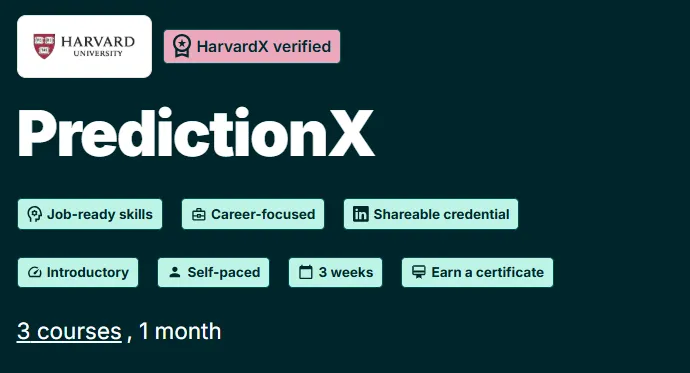
What will you learn in PredictionX course
- This XSeries program explores the intellectual history and scientific foundations of prediction across cultures and disciplines.
- Learners will understand how ancient forecasting practices evolved into modern probability, statistics, and predictive modeling.
- The program emphasizes the transition from divination and prophecy to mathematical and scientific forecasting systems.
- Students will examine risk assessment, uncertainty, and decision-making under incomplete information.
- Interdisciplinary case studies connect prediction to economics, science, public policy, and data analysis.
- By completing the series, participants gain a deeper understanding of how predictive thinking shapes modern society.
Program Overview
Ancient Traditions of Prediction
⏳ 4–6 Weeks
- Explore divination, astrology, and prophecy in early civilizations.
- Understand the cultural role of oracles and omens.
- Analyze prediction in religious and political contexts.
- Study early symbolic systems of forecasting.
Emergence of Probability and Statistics
⏳ 4–6 Weeks
- Learn how probability theory developed.
- Understand the mathematics behind risk and uncertainty.
- Explore early statistical models.
- Analyze how prediction shifted toward scientific reasoning.
Modern Forecasting and Decision-Making
⏳ 4–6 Weeks
- Study economic and financial forecasting methods.
- Understand weather prediction and scientific modeling.
- Explore predictive analytics and data-driven insights.
- Analyze ethical implications of predictive systems.
Get certificate
Job Outlook
- While humanities-focused, this program strengthens analytical reasoning, historical perspective, and interdisciplinary thinking.
- Professionals in economics, public policy, data communication, journalism, and research benefit from understanding predictive frameworks.
- Knowledge of forecasting foundations supports roles in risk analysis, strategic planning, and analytics-related careers.
- The program also enhances preparation for graduate studies in statistics, economics, history of science, and policy analysis.