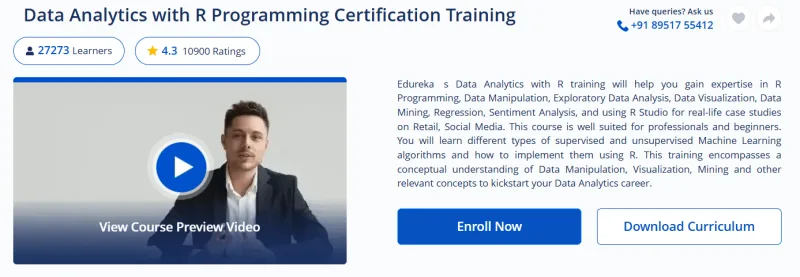
What will you learn in Data Analytics with R Programming Certification Training Course
-
Perform data import, cleaning, and manipulation in R using
readr,dplyr, andtidyr -
Visualize data with
ggplot2: scatterplots, bar charts, histograms, boxplots, and thematic customization -
Apply statistical analysis: summary statistics, hypothesis testing (t-tests, chi-square), correlation, and ANOVA in R
-
Build predictive models with linear and logistic regression, decision trees, and random forests using
caret -
Automate reporting with R Markdown and Shiny apps for interactive dashboards and reproducible analysis
Program Overview
Module 1: R Environment & Data Import
⏳ 2 hours
-
Topics: Installing R/RStudio, package management, working directory, data types
-
Hands-on: Load CSV, Excel, and JSON datasets; inspect with
str(),glimpse(), and summary functions
Module 2: Data Wrangling with dplyr & tidyr
⏳ 3 hours
-
Topics:
filter(),select(),mutate(),summarize(),group_by(),pivot_longer(),pivot_wider() -
Hands-on: Clean messy survey data, reshape wide ↔ long, derive new variables
Module 3: Exploratory Data Visualization
⏳ 3 hours
-
Topics: Grammar of graphics,
ggplot2aesthetics, scales, facets, themes -
Hands-on: Create and customize multi-panel plots to reveal trends and outliers
Module 4: Statistical Analysis in R
⏳ 2.5 hours
-
Topics: Descriptive stats, confidence intervals, t-tests, chi-square tests, one-way ANOVA
-
Hands-on: Test differences in group means and associations between categorical variables
Module 5: Predictive Modeling with caret
⏳ 4 hours
-
Topics: Data partitioning, cross-validation, training linear/logistic regression, decision trees, random forests
-
Hands-on: Build and compare model performance (RMSE, accuracy), tune hyperparameters
Module 6: Advanced Visualization & Reporting
⏳ 2 hours
-
Topics: Interactive plots with
plotly, dashboards with Shiny, reproducible reports with R Markdown -
Hands-on: Deploy a Shiny app showcasing key metrics; generate a PDF report from R Markdown
Module 7: Capstone Project – End-to-End Analytics Workflow
⏳ 4 hours
-
Topics: Project scoping, data pipeline, analysis, modeling, visualization, and presentation
-
Hands-on: Execute a complete analytics case study (e.g., customer churn, sales forecasting) and deliver an interactive dashboard
Get certificate
Job Outlook
-
Data Analyst: $65,000–$90,000/year — extract insights and build visual reports using R in finance, healthcare, and marketing
-
Business Intelligence Analyst: $70,000–$100,000/year — develop dashboards and statistical models to inform strategic decisions
-
Statistical Programmer / R Developer: $75,000–$110,000/year — implement data pipelines, develop Shiny apps, and automate analyses
Explore More Learning Paths
Take your engineering and management expertise to the next level with these hand-picked programs designed to expand your skills and boost your leadership potential.
Related Courses
-
Google Advanced Data Analytics Capstone Course – Apply advanced analytical techniques to real-world datasets and build portfolio-ready projects.
-
Google Data Analytics Capstone: Complete a Case Study Course – Strengthen your data analytics skills by completing a full case study based on professional, real-life scenarios.
-
Google Advanced Data Analytics Professional Certificate Course – Gain job-ready expertise in statistical analysis, modelling, and machine learning with Google’s advanced analytics curriculum.
Related Reading
-
What Is Project Management? – Understand the principles that make every great project a success story.