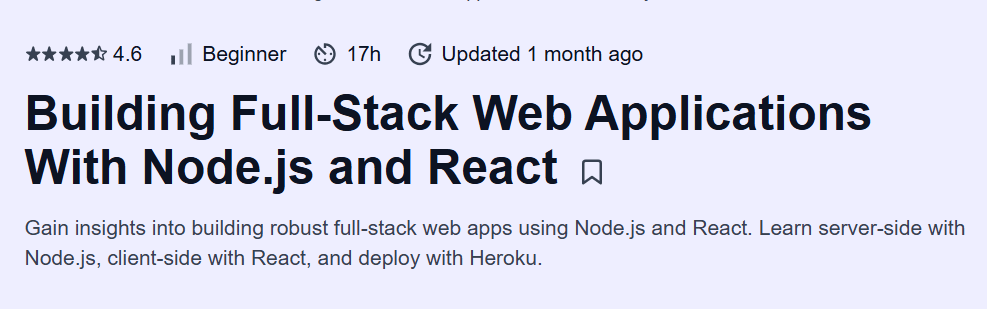
What will you learn in Building Full-Stack Web Applications With Node.js and React Course
-
Architect and implement RESTful APIs with Node.js, Express, and MongoDB
-
Build dynamic front-ends using React, React Router, and Redux for state management
-
Connect front-end and back-end via asynchronous HTTP calls and real-time WebSockets
-
Secure your application with JWT authentication, role-based access control, and robust input validation
-
Deploy and containerize your full-stack app using Docker, CI/CD pipelines, and serverless functions
Program Overview
Module 1: Project Setup & Node.js Fundamentals
⏳ 1 week
-
Topics: Node.js runtime, npm/Yarn, ES6+ syntax, Express.js basics
-
Hands-on: Scaffold a new project, install dependencies, and build your first Express server
Module 2: RESTful APIs with Express & MongoDB
⏳ 1 week
-
Topics: CRUD routes, Mongoose schemas/models, query filtering, pagination
-
Hands-on: Create user and product endpoints, test them with Postman
Module 3: Authentication & Authorization
⏳ 1 week
-
Topics: JWTs, password hashing with bcrypt, middleware patterns, role checks
-
Hands-on: Implement signup/login flows, protect routes, and enforce admin vs. user permissions
Module 4: React Front-End Foundations
⏳ 1 week
-
Topics: JSX, functional components, React Hooks (
useState,useEffect), conditional rendering -
Hands-on: Build a responsive UI to consume your REST API
Module 5: State Management & Routing
⏳ 1 week
-
Topics: React Router for client-side navigation, Redux for global state, async thunks
-
Hands-on: Wire up protected routes and manage auth state in Redux
Module 6: Real-Time with WebSockets
⏳ 1 week
-
Topics:
socket.iosetup on server and client, event broadcasting, rooms -
Hands-on: Add a live chat or notification feed to your app
Module 7: Testing & Validation
⏳ 1 week
-
Topics: Jest and React Testing Library, API input validation with Joi, centralized error handling
-
Hands-on: Write unit and integration tests for both back-end endpoints and front-end components
Module 8: Deployment & DevOps
⏳ 1 week
-
Topics: Dockerfile & Docker Compose, CI/CD with GitHub Actions, environment configurations, AWS Lambda basics
-
Hands-on: Containerize your app, set up automated build/test/deploy pipeline, deploy to a cloud provider
Get certificate
Job Outlook
-
Full-stack JavaScript developers are in high demand across startups and enterprise teams
-
Roles include Full-Stack Developer, MERN Stack Engineer, and Solutions Architect
-
Salaries range from $95,000 to $150,000+ based on experience and geography
-
Mastery of Node.js and React, along with DevOps practices, positions you for leadership in modern web engineering
Explore More Learning Paths
Take your full-stack web development skills to the next level with these hand-picked programs designed to help you build scalable, dynamic web applications using modern JavaScript technologies.
Related Courses
-
Microsoft Full-Stack Developer Professional Certificate Course – Learn end-to-end full-stack development, including front-end, back-end, databases, and cloud deployment.
-
Meta Full-Stack Developer Specialization Course – Gain practical experience building full-stack applications with JavaScript, React, and Node.js, guided by industry experts.
-
IBM Full-Stack JavaScript Developer Professional Certificate Course – Master full-stack development with a focus on JavaScript technologies, APIs, and cloud integration for real-world projects.
Related Reading
Gain deeper insight into how structured knowledge supports full-stack development:
-
What Is Knowledge Management? – Explore how organizing and leveraging programming knowledge enhances efficiency, project scalability, and application quality.