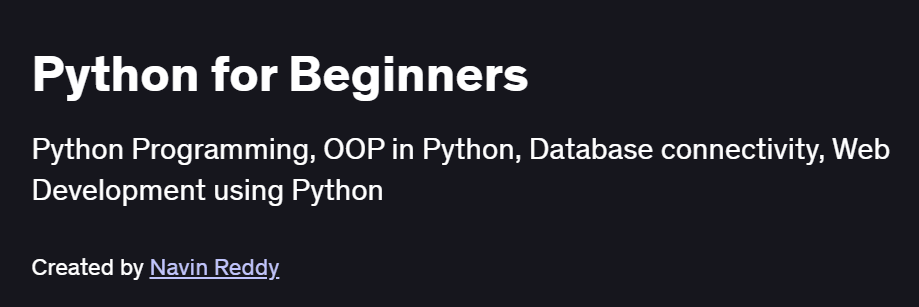
What will you in Python for Beginners Course
- Install Python, set up your development environment (IDEs, virtual environments)
- Work with Python basics: variables, data types, control flow (if, loops), and functions
- Manipulate collections: lists, tuples, dictionaries, and sets with comprehension techniques
- Read/write files, handle exceptions, and use modules/packages for code organization
- Explore object-oriented programming: classes, inheritance, and special methods
Program Overview
Module 1: Setup & Python Fundamentals
⏳ 45 minutes
-
Installing Python, configuring IDEs (VS Code/PyCharm), and using
venv -
Hello World, basic arithmetic, variables, and data types
Module 2: Control Flow & Functions
⏳ 1 hour
-
ifstatements,forandwhileloops, andbreak/continue -
Defining and calling functions, scope, default/keyword arguments
Module 3: Collections & Comprehensions
⏳ 1 hour
-
Working with lists, tuples, dictionaries, and sets
-
List/dict/set comprehensions and generator expressions
Module 4: File I/O & Error Handling
⏳ 45 minutes
-
Opening, reading, and writing text/binary files
-
try/exceptblocks,finally, and custom exception classes
Module 5: Modules, Packages & Virtual Environments
⏳ 45 minutes
-
Structuring code into modules and packages
-
Installing and managing dependencies with
pipandrequirements.txt
Module 6: Object-Oriented Python
⏳ 1 hour
-
Defining classes, attributes, methods, and
__init__ -
Inheritance, method overriding, and using
super()
Module 7: Working with Standard Libraries
⏳ 45 minutes
-
Using built-ins:
datetime,collections,os, andjson -
Introduction to popular third-party libraries (e.g., Requests, Pandas overview)
Module 8: Capstone Project & Next Steps
⏳ 45 minutes
-
Building a small CLI tool or data-processing script
-
Resources for advanced learning: web frameworks, data science, and testing
Get certificate
Job Outlook
- Python skills open doors to roles like Junior Python Developer, QA Automation Engineer, and Data Analyst
- Widely used in web development (Django/Flask), automation, scripting, and data science
- Strong foundation for progressing to libraries and frameworks: Flask, Django, Pandas, and Selenium
- High demand across industries for rapid prototyping, API development, and tooling
Explore More Learning Paths
Take your Python skills from basic to advanced with these carefully selected courses designed to help you build practical programming expertise and career-ready knowledge.
Related Courses
-
Python 3 Programming Specialization Course – Gain in-depth knowledge of Python 3 and learn to apply it in finance, data analysis, and real-world projects.
-
Python Programming Fundamentals Course – Build a strong foundation in Python syntax, data types, and programming logic for practical coding applications.
-
Introduction to Python Programming Course – Start your Python journey with beginner-friendly lessons and hands-on exercises to confidently write your first programs.
Related Reading
-
What Is Python Used For? – Explore the real-world applications of Python across industries, from web development to data science.