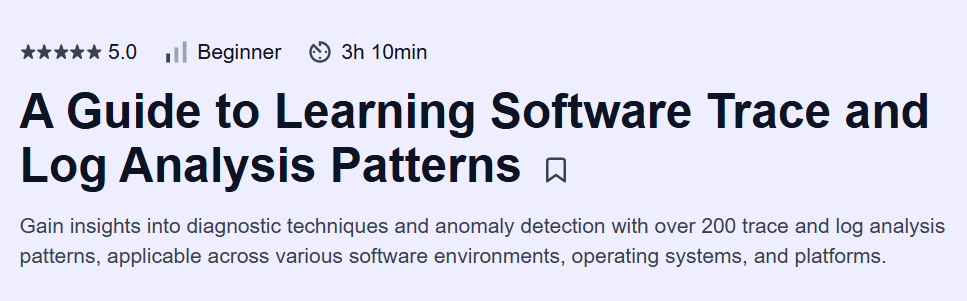
A Guide to Learning Software Trace and Log Analysis Patterns Course

A Guide to Learning Software Trace and Log Analysis Patterns Course Course

A practical, tool-agnostic course that takes you from basic logging to full distributed tracing and alerting, ideal for engineers owning production reliability.

Explore This Course
9.7/10 Highly Recommended

A Guide to Learning Software Trace and Log Analysis Patterns Course on Educative — A practical, tool-agnostic course that takes you from basic logging to full distributed tracing and alerting, ideal for engineers owning production reliability.

Pros

  • Hands-on labs covering both logging and tracing ecosystems
  • Strong emphasis on patterns, best practices, and cost management
  • Real-world capstone mimics production observability challenges

Cons

  • Assumes familiarity with Linux and basic deployment tooling
  • Does not deep-dive into proprietary platforms like Splunk (focuses on open-source stacks)

A Guide to Learning Software Trace and Log Analysis Patterns Course Course

Platform: Educative

What will you learn in A Guide to Learning Software Trace and Log Analysis Patterns Course

  • Understand the fundamentals of software tracing and log collection across distributed systems

  • Learn key log analysis patterns: error detection, performance profiling, correlation, and anomaly detection

  • Master tools and techniques for parsing, aggregating, and visualizing logs (e.g., Elasticsearch/Kibana, Splunk)

​​​​​​​​​​

  • Apply structured logging, context propagation, and sampling strategies for scalable observability

  • Develop automated alerting and dashboards to monitor application health

Program Overview

Module 1: Introduction to Tracing & Logging

⏳ 1 week

  • Topics: Roles of traces vs. metrics vs. logs; log formats (JSON, key-value); centralized vs. local storage

  • Hands-on: Instrument a sample microservice to emit structured logs

Module 2: Log Collection & Aggregation

⏳ 1 week

  • Topics: Log shippers (Fluentd, Logstash), queues (Kafka), storage backends (Elasticsearch, S3)

  • Hands-on: Deploy a Fluentd pipeline shipping logs to Elasticsearch

Module 3: Analysis Patterns & Queries

⏳ 1 week

  • Topics: Search queries, filtering, faceting; common patterns: request tracing, error rate spikes, slow-query identification

  • Hands-on: Write Kibana queries to detect service-level errors and correlate them with latency spikes

Module 4: Visualization & Dashboards

⏳ 1 week

  • Topics: Dashboard design principles, time-series charts, anomaly detection visualizations

  • Hands-on: Build a real-time dashboard tracking throughput, error rates, and 95ᵗʰ latency percentile

Module 5: Correlation & Distributed Tracing Basics

⏳ 1 week

  • Topics: Trace IDs, span contexts, sampling strategies; integration with OpenTelemetry or Zipkin

  • Hands-on: Instrument a multi-service workflow to propagate trace IDs and visualize spans

Module 6: Alerting & Automation

⏳ 1 week

  • Topics: Threshold alerts, anomaly detection rules, integration with PagerDuty/Slack

  • Hands-on: Configure alerts on error surges and latency regressions

Module 7: Advanced Topics & Best Practices

⏳ 1 week

  • Topics: Log retention policies, index lifecycle management, cost optimization, security considerations

  • Hands-on: Implement ILM policies in Elasticsearch to roll over and purge old logs

Module 8: Capstone Project

⏳ 1 week

  • Topics: End-to-end observability solution design and implementation

  • Hands-on: Build a full tracing and logging pipeline for a sample e-commerce app, including dashboards and alert rules

Get certificate

Job Outlook

  • Observability and log-analysis expertise are critical for Site Reliability Engineers, DevOps Engineers, and Platform Engineers

  • Roles demand proficiency with logging frameworks, ELK/EFK stacks, Splunk, and distributed tracing tools

  • Salaries range from $110,000 to $170,000+ depending on region and experience

  • In high demand across cloud-native, microservices, and large-scale SaaS environments

Related Reading

  • What Is Data Management? — Understand how effective data organization and analysis enable professionals to interpret system logs, detect anomalies, and improve software performance.
FAQs

Do I need prior programming experience to understand software trace and log analysis?
Basic familiarity with programming concepts can help, but it’s not mandatory. Understanding common data structures makes analyzing logs easier. Knowledge of file handling or text parsing is beneficial. The course focuses more on patterns and analysis rather than coding. Learners can still follow along using examples provided in the course.
Can this course help me in debugging real-world applications?
Yes, learning trace patterns helps identify issues faster in live applications. Understanding logs can reduce time spent on root cause analysis. Patterns discussed can be applied across different programming languages. It teaches systematic approaches to interpreting complex logs. Skills from the course can complement standard debugging tools.
Will this course cover log management tools like Splunk or ELK Stack?
The course primarily emphasizes analysis patterns rather than specific tools. It provides the foundational knowledge to work with any log management system. Understanding patterns makes it easier to adapt to different platforms. Learners can practice on their preferred tools independently. Tool-specific tutorials can be combined with this course for hands-on experience.
Is this course suitable for software testers or QA professionals?
Absolutely, QA roles benefit from understanding software behavior through logs. It enhances the ability to verify system functionality and catch hidden bugs. Logs can provide insights for performance testing and error tracking. Testers can create more effective test cases using patterns learned. Skills learned can also improve collaboration with developers during debugging.
How much hands-on practice can I expect in this course?
The course includes examples and exercises to reinforce concepts. You will analyze sample traces and logs to recognize patterns. Hands-on practice helps in applying theory to real-life scenarios. Students can work on personal projects to enhance understanding. Additional practice outside the course is recommended for mastery.

Similar Courses

Other courses in Software Development Courses