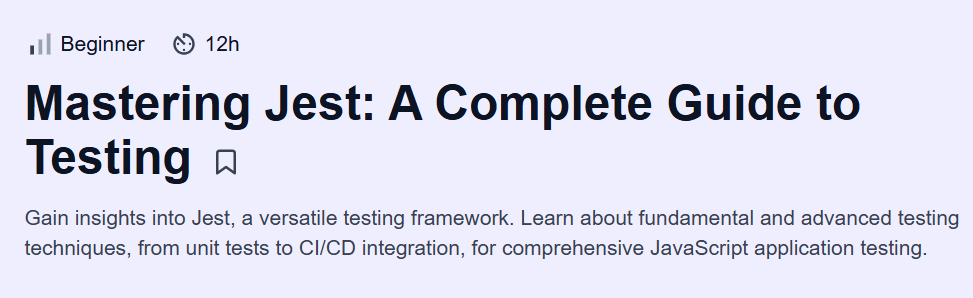
What will you learn in Mastering Jest: A Complete Guide to Testing Course
- Gain hands-on experience writing clean, meaningful tests with Jest’s intuitive API for JavaScript and TypeScript applications
- Master Jest’s core matchers, snapshot testing, and custom matcher creation to ensure UI and logic consistency
- Test asynchronous code—callbacks, Promises, and async/await—with confidence and accuracy
- Mock functions, timers, classes, and external libraries (Axios, date utilities, SDKs) to isolate units and simulate dependencies
- Integrate Jest into CI/CD pipelines with coverage reporting, GitHub Actions, and CircleCI for a robust, automated testing workflow
Program Overview
Module 1: Introduction
⏳ 15 minutes (2 Lessons)
-
Topics: What is Jest; the three primary test types (unit, snapshot, integration)
-
Hands-on: Explore the “Test with Jest” example and quiz your understanding of Jest fundamentals
Module 2: Setting Up Jest
⏳ 30 minutes (4 Lessons + Quiz)
-
Topics: Configuring Jest for JavaScript and TypeScript; structuring test files; debugging tests
-
Hands-on: Install and configure Jest in a sample project; debug a failing test case
Module 3: Jest Matchers
⏳ 45 minutes (5 Lessons + Quiz)
-
Topics: Built-in matchers, error handling, Jest Extended, creating custom matchers
-
Hands-on: Write tests using common and extended matchers; build a custom matcher for your data types
Module 4: Writing Unit Tests
⏳ 45 minutes (5 Lessons + Quiz)
-
Topics: Structuring clean unit tests, global helpers, best practices
-
Hands-on: Refactor a legacy function into well-organized unit tests with clear assertions
Module 5: Snapshot Testing
⏳ 30 minutes (4 Lessons + Quiz)
-
Topics: Introduction to snapshots, creating and maintaining snapshots, avoiding common pitfalls
-
Hands-on: Add snapshot tests for React components or JSON outputs and update snapshots safely
Module 6: Testing Asynchronous Code
⏳ 45 minutes (5 Lessons + Quiz)
-
Topics: Callbacks, Promises, async/await patterns in tests
-
Hands-on: Write tests for an API-fetch function using callbacks, Promises, and async/await
Module 7: Mocking Core Functions & Timers
⏳ 60 minutes (6 Lessons)
-
Topics:
jest.fn(), timer mocks, class mocks, client/server mocking patterns -
Hands-on: Mock timers and API calls to simulate timeouts and network responses
Module 8: Mocking External Libraries
⏳ 75 minutes (8 Lessons + Project)
-
Topics: Techniques for mocking Axios, date libraries, analytics SDKs, charting packages, and more
-
Hands-on: Complete the “Working with Jest Mocks” project, mocking multiple third-party packages
Module 9: Setup & Teardown
⏳ 30 minutes (4 Lessons + Quiz)
-
Topics: Test isolation, global setup/teardown, per-test hooks
-
Hands-on: Implement
beforeAll/afterAllhooks in a database integration test suite
Module 10: Test Coverage & CI/CD Pipelines
⏳ 30 minutes (4 Lessons + Quiz)
-
Topics: Generating coverage reports, enforcing coverage thresholds, integrating with GitHub Actions and CircleCI
-
Hands-on: Configure a GitHub Actions workflow to run Jest tests and upload coverage badges
Get certificate
Job Outlook
- The average salary for a QA/Test Engineer in the U.S. is $99,648 per year, reflecting strong demand for automated-testing expertise
- Jest skills are highly valued in JavaScript and full-stack roles across tech, finance, e-commerce, and media industries
- Proficiency in Jest testing opens opportunities as Frontend Developer, QA Automation Engineer, and DevOps Engineer with testing focus
- Integrating tests early in CI/CD pipelines aligns with modern DevOps and SRE practices, boosting team productivity and code quality