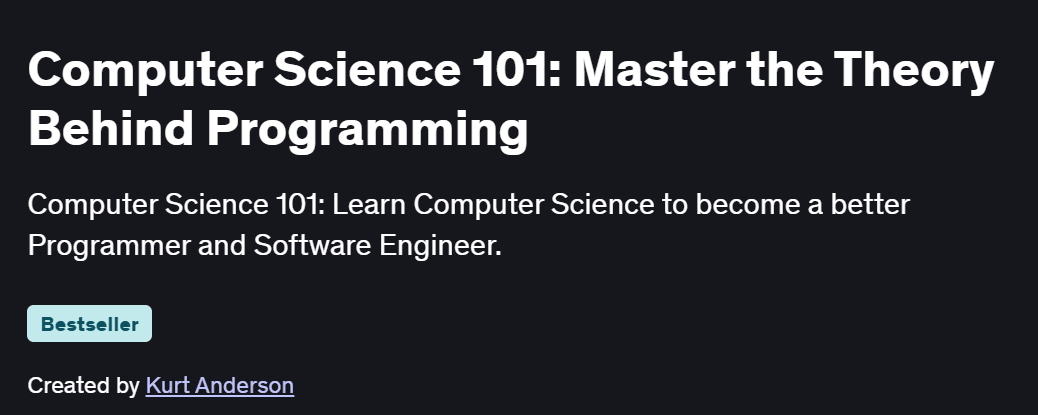
What will you in Computer Science 101: Master the Theory Behind Programming Course
-
Understand fundamental computer science concepts: algorithms, data structures, and computational complexity
-
Grasp how memory, CPU, and I/O interact in program execution and operating systems
-
Analyze and design efficient algorithms for sorting, searching, and graph traversal
-
Apply key data structures—arrays, linked lists, stacks, queues, trees, and hash tables in code
-
Evaluate time and space complexity using Big O notation for real-world problem solving
Program Overview
Module 1: Introduction to Computer Science & Architecture
⏳ 30 minutes
-
CPU, memory hierarchy, and instruction execution cycle
-
Von Neumann architecture, binary representation, and data encoding
Module 2: Data Structures Fundamentals
⏳ 1 hour
-
Arrays vs. linked lists: trade-offs in access and manipulation
-
Implementing stacks and queues for LIFO/FIFO operations
Module 3: Algorithm Analysis & Big O
⏳ 45 minutes
-
Measuring performance: best, average, and worst-case scenarios
-
Big O notation rules for common operations
Module 4: Sorting & Searching Algorithms
⏳ 1 hour
-
Implementing and comparing bubble, insertion, merge, and quick sort
-
Binary search on sorted arrays and its logarithmic complexity
Module 5: Trees & Graphs
⏳ 1 hour
-
Binary trees, traversals (in-/pre-/post-order), and tree properties
-
Graph representations and traversal algorithms: DFS and BFS
Module 6: Hashing & Hash Tables
⏳ 45 minutes
-
Hash functions, collision resolution (chaining, open addressing)
-
Use cases for constant-time lookup and caching
Module 7: Recursion & Dynamic Programming
⏳ 45 minutes
-
Recursive problem decomposition and call stack behavior
-
Memoization patterns and bottom-up DP for optimization
Module 8: Putting It All Together & Best Practices
⏳ 30 minutes
-
Designing end-to-end algorithmic solutions for sample problems
-
Trade-offs, code readability, and choosing the right abstraction
Get certificate
Job Outlook
-
Core CS theory underpins roles like Software Engineer, Systems Architect, and DevOps Engineer
-
Essential for technical interviews at top tech companies and algorithm-driven startups
-
Provides a foundation for advanced fields: machine learning, database internals, and high-performance computing
-
Equips you to optimize code for real-world applications and drive system-level improvements
Explore More Learning Paths
Strengthen your computer science foundation with these carefully curated courses designed to help you understand programming theory, computational thinking, and core CS concepts.
Related Courses
-
Introduction to Computer Science and Programming Specialization Course – Build a solid understanding of computer science fundamentals and programming basics.
-
Accelerated Computer Science Fundamentals Specialization Course – Learn key computer science principles quickly while applying them through practical exercises.
-
Mathematical Thinking in Computer Science Course – Develop logical and mathematical reasoning skills essential for programming and algorithm design.
Related Reading
-
What Is Data Management? – Explore the importance of organizing and managing data efficiently for programming and computational tasks.