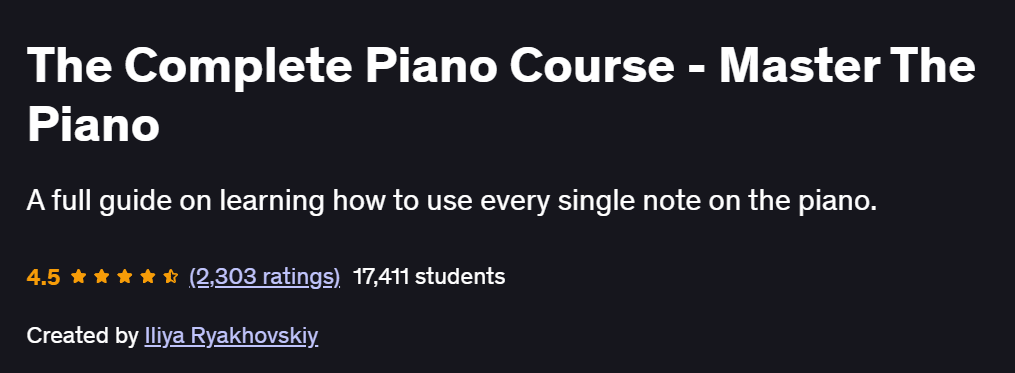
What will you in The Complete Piano Course – Master The Piano Course
- Navigate the piano keyboard, establish proper posture, and develop healthy hand technique
- Read standard notation: the grand staff, clefs, note values, and basic rhythms
- Play major and minor scales, arpeggios, and foundational finger-strengthening exercises
- Construct and use triads, seventh chords, and simple chord progressions in both hands
- Develop sight-reading skills, ear training, and basic improvisation techniques
Program Overview
Introduction & Keyboard Fundamentals
⏳ 30 minutes
-
Understanding piano anatomy, seating position, and finger numbering
-
Setting up an effective practice environment
Reading Music Notation
⏳ 45 minutes
-
Grand staff, treble and bass clefs, note durations, and rests
-
Counting rhythms in simple time signatures (4/4, 3/4)
Scales, Arpeggios & Finger Exercises
⏳ 1 hour
-
One-octave major and minor scales with correct fingering
-
Arpeggio patterns and Hanon-style drills for dexterity
Chord Construction & Harmony
⏳ 1 hour
-
Building triads and seventh chords in various inversions
-
Hands-together exercises for basic chord progressions (I–IV–V, ii–V–I)
Hands-Together Repertoire
⏳ 1 hour
-
Learn two beginner to early-intermediate pieces integrating melody and accompaniment
-
Techniques for synchronizing hands and maintaining tempo
Dynamics & Articulation
⏳ 45 minutes
-
Using dynamics (p, mf, f) and expressive markings
-
Articulation: legato, staccato, phrasing, and pedaling basics
Sight-Reading & Ear Training
⏳ 45 minutes
-
Progressive sight-reading exercises for fluency
-
Interval and chord recognition drills to strengthen musical ear
Practice Strategies & Next Steps
⏳ 30 minutes
-
Structuring daily sessions: warm-up, technique, repertoire, review
-
Goal setting, progress tracking, and resources for continued learning
Get certificate
Job Outlook
- Piano skills are valuable for roles as accompanist, worship musician, and ensemble player
- Provides a strong foundation for private teaching, studio work, and collaborative projects
- Enhances songwriting, arranging, and composition capabilities across genres
- Opens pathways to advanced study in classical performance, jazz improvisation, and music education
Explore More Learning Paths
Elevate your piano skills and explore diverse music styles with these curated courses, designed to help you play confidently, creatively, and professionally.
Related Courses
-
Piano Techniques for Modern Music Course – Learn modern piano techniques and versatile playing styles for contemporary music.
-
Piano for Singer-Songwriters: Write Songs and Perform Live Course – Combine piano skills with songwriting and live performance to bring your music to life.
-
Beginner Piano Course – Build a strong foundation in piano playing, from basic notes and chords to simple songs.
Related Reading
-
What Is Performance Management? – Gain insights into structured practice and improving performance, applicable to mastering the piano.