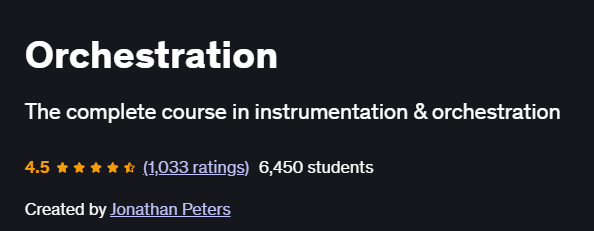
What will you learn in Orchestration Course
-
Understand the full orchestra: each instrument’s construction, sound production, notation, transposition, range, register strengths, dynamics, and playing techniques
-
Prepare professional scores and parts, including proofreading tips before publishing or performance
-
Employ timbral and textural strategies: spacing, voicing in orchestral chords, instrument combinations, and roles within the ensemble
-
Read and interpret scores effectively, reinforced with hundreds of examples, diagrams, audio clips, and nearly 1,000 quiz questions
Program Overview
Module 1: Instrumentation – Woodwinds & Brass
⏳ 3 hours
-
Topics: Detailed study of woodwind and brass instruments—their anatomy, sound production, ranges, transposition, and notational conventions
-
Hands-on: Analyze score excerpts, map parts for each instrument, and complete quiz questions on woodwind/brass characteristics
Module 2: Instrumentation – Strings & Percussion
⏳ 3 hours
-
Topics: String and percussion families—construction, timbral possibilities, playing techniques, dynamic capabilities, and notation
-
Hands-on: Create instrumentation charts, assign parts in sample passages, and proof percussion notation examples
Module 3: Orchestration Techniques
⏳ 4 hours
-
Topics: Chord spacing and voicing for orchestra; blending sections; timbral contrast and texture creation techniques
-
Hands-on: Score a short four-part orchestral chord progression with proper voicing and register mapping
Module 4: Score & Parts Preparation
⏳ 2 hours
-
Topics: Best practices for preparing conductor scores and individual parts, proofing workflows, and alignment checks
-
Hands-on: Format a mini-score and extract parts, then execute a proofing checklist on notation accuracy
Module 5: Timbre, Texture & Color
⏳ 3 hours
-
Topics: Exploring orchestral color—instrument combinations, dynamic layering, and textural depth; use of extended techniques
-
Hands-on: Design three contrasting orchestral textures for a given melody using different section groupings
Module 6: Score Reading & Analysis
⏳ 3 hours
-
Topics: Strategies for effective score reading; historical and stylistic context; interpreting composer intent
-
Hands-on: Complete listening/reading assignments with score excerpts, followed by analytical quizzes
Module 7: Orchestration Tips & Appendix Resources
⏳ 2 hours
-
Topics: Advanced tips and techniques from award-winning composer; reference charts, external resource compilation
-
Hands-on: Utilize appendix charts to orchestrate a brief passage and validate choices against recommended guidelines
Get certificate
Job Outlook
-
Orchestration skills are in demand for film scores, game audio, concert works, and virtual instrument sample libraries.
-
Freelance orchestrators earn $50–$150 per hour depending on project scope and reputation; staff orchestrators in media industries can command salaries of $60k–$100k USD annually.
-
Mastery of orchestration enhances career paths as composers, arrangers, copyists, and music editors in classical, media, and gaming sectors.
-
Proficiency in score preparation tools and deep knowledge of instrument capabilities open opportunities in education, publishing, and software sound development.