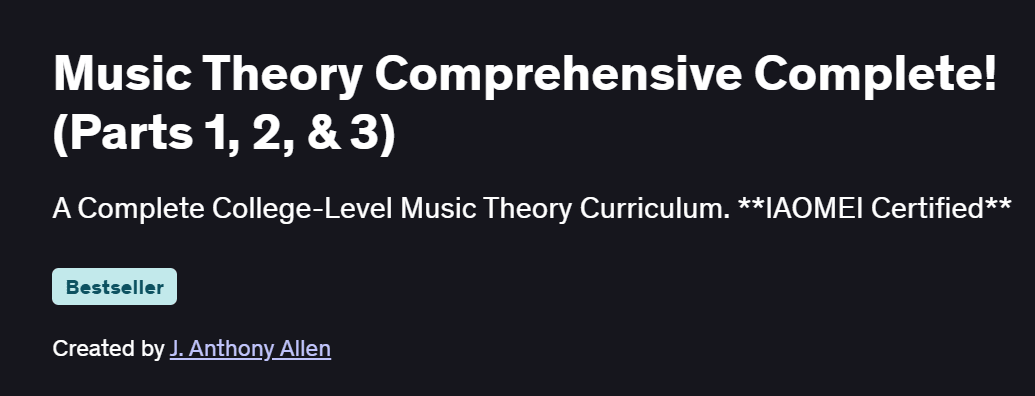
What will you in Music Theory Comprehensive Complete! (Parts 1, 2, & 3) Course
- Read and write standard musical notation with confidence
- Understand scales, modes, intervals, and key signatures
- Analyze chord construction, progressions (diatonic and secondary), and harmonic function
- Master rhythm, meter, and advanced concepts like syncopation and polyrhythms
- Apply music theory to composition, arrangement, and improvisation
Program Overview
Part 1: Notation & Pitch Fundamentals
⏳ 45 minutes
-
The staff, clefs, note values, and naming pitches
-
Ledger lines, accidentals, and octave transpositions
Part 2: Scales, Keys & Modes
⏳ 1 hour
-
Major and natural/minor scales, relative and parallel minors
-
Church modes (Ionian through Locrian) and modal characteristics
Part 3: Intervals & Ear Training
⏳ 45 minutes
-
Interval identification, quality (major, minor, perfect, augmented, diminished)
-
Practical ear-training exercises for melodic and harmonic intervals
Part 4: Rhythm, Meter & Subdivision
⏳ 1 hour
-
Simple, compound, and mixed meters
-
Syncopation, ties, dotted rhythms, and tuplets
Part 5: Chord Construction & Harmony
⏳ 1 hour
-
Triads, seventh chords, extended tertian harmony (9ths, 11ths, 13ths)
-
Voice leading rules and four-part chorale style
Part 6: Chord Progressions & Functional Harmony
⏳ 1 hour
-
Diatonic progressions (I–IV–V, ii–V–I) and secondary dominants
-
Modulation techniques and pivot-chord transitions
Part 7: Advanced Topics & Application
⏳ 1 hour
-
Modal interchange, borrowed chords, and chromatic harmony
-
Applying theory to songwriting, arrangement, and improvisation frameworks
Get certificate
Job Outlook
- A solid grounding in music theory is essential for composers, arrangers, and session musicians
- Highly valued in roles like Music Educator, Arranger, and Producer across genres (classical, jazz, pop)
- Enables confident chart reading, transcription, and collaboration in professional studios
- Provides a foundation for advanced studies in composition, orchestration, and audio production
Explore More Learning Paths
Strengthen your music theory foundation and enhance your overall musicianship with these hand-picked courses, designed to help you compose, arrange, and perform with confidence.
Related Courses
-
Developing Your Musicianship Course – Build core musicianship skills, including ear training, rhythm, and fundamental music theory concepts.
-
Music Theory for Electronic Musicians Part 1: Chords Course – Learn essential chord structures and harmonies tailored for electronic music production.
-
Songwriting Simplified: Music Theory, Melody & Creativity Course – Apply music theory to create compelling melodies and boost your creativity in songwriting.
Related Reading
-
What Is Performance Management? – Discover strategies for tracking progress and improving performance, valuable for structured practice and composition.