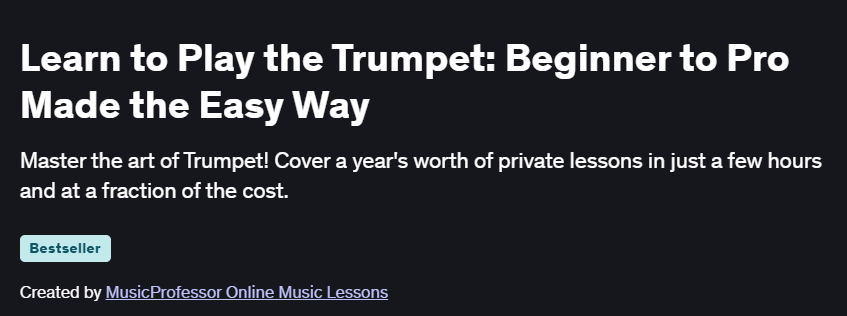
What will you learn in Learn to Play the Trumpet: Beginner to Pro Made the Easy Way Course
-
Assemble, care for, and maintain your trumpet—including cleaning, lubrication, and mouthpiece fitting.
-
Develop a clear, centered tone through correct embouchure, air support, and posture.
-
Read standard music notation and map notes on the staff to trumpet fingerings across all three valves.
-
Play a variety of simple tunes—from folk melodies to basic lead‐sheet lines—following step-by-step guidance.
-
Master major scales and essential technical exercises to build dexterity, range, and confidence.
Program Overview
Module 1: Assembly & Maintenance
⏳ 30 minutes
-
Topics: Trumpet parts and assembly; cleaning slides and valves; oiling techniques
-
Hands-on: Disassemble your trumpet, perform a basic cleaning routine, and reassemble it correctly
Module 2: Embouchure & Tone Production
⏳ 45 minutes
-
Topics: Lip and jaw positioning; diaphragm breathing exercises; producing a stable buzz
-
Hands-on: Practice long-tone exercises and mouthpiece buzzing drills to develop a warm, consistent sound
Module 3: Music Notation & Fingering Charts
⏳ 45 minutes
-
Topics: Note values, key signatures, and reading treble clef notation for trumpet
-
Hands-on: Play written examples using animated fingering charts to reinforce staff-to-valve coordination
Module 4: Melodies & Repertoire
⏳ 1 hour
-
Topics: Step-by-step learning of familiar tunes (e.g., “Hot Cross Buns,” “Ode to Joy”) and simple jazz licks
-
Hands-on: Perform each melody along with backing tracks, focusing on intonation and rhythmic stability
Module 5: Scales & Technique Exercises
⏳ 30 minutes
-
Topics: Major scales in common keys, arpeggio drills, lip slurs, and valve-transition exercises
-
Hands-on: Run through scale and slur exercises to build flexibility, accuracy, and smooth valve changes
Module 6: Practice Strategies & Troubleshooting
⏳ 30 minutes
-
Topics: Effective warm-ups, practice routines, and common beginner pitfalls (e.g., squeaks, fatigue)
-
Hands-on: Apply targeted fixes—adjusting mouthpiece placement, modifying breath support—to resolve tone issues
Get certificate
Job Outlook
-
Private Trumpet Teachers: $35–$60 per hour, with demand in schools, studios, and online platforms.
-
Session & Freelance Work: $25–$45 per hour for studio sessions, wedding/event gigs, and pit orchestras.
-
Orchestral Positions: Regional ensemble salaries range $25k–$50k annually; top orchestras pay $60k–$100k.
-
Strong sight-reading ability and range development open doors in jazz bands, pit orchestras, and recording projects.
Explore More Learning Paths
Expand your musical skills and master wind instruments with these carefully selected courses designed to help you progress from beginner to advanced levels.
Related Courses
-
Learn to Play the Flute: Beginner Basics to Intermediate Course – Build a strong foundation in flute playing, covering technique, music reading, and practice routines.
-
Learn to Play Saxophone: Beginner to Pro in Under Four Hours Course – Quickly develop saxophone skills with structured exercises and practical tips for performance.
-
Learn to Play Clarinet: Beginner to Pro in Under Five Hours Course – Master clarinet basics and advance to professional-level playing with step-by-step guidance.
Related Reading
-
What Is Performance Management? – Learn how consistent practice and skill assessment enhance your musical performance and growth over time.