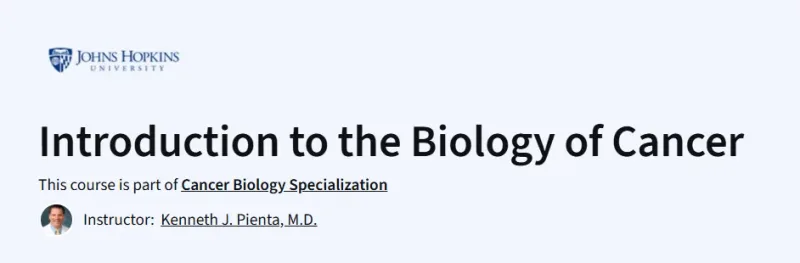
What will you learn in Introduction to the Biology of Cancer Course
-
Explore how widespread cancer is, and discover the most common types across the globe.
-
Learn how genetics—like oncogenes and tumor suppressor genes—drive cancer development.
-
Understand the ten cellular hallmarks of cancer that distinguish healthy cells from cancerous ones.
-
Grasp the mechanisms of metastasis and how cancer spreads through the body.
-
See how imaging tools are used for diagnosis, staging, and treatment planning in oncology.
-
Dive into cancer treatment methods, including clinical trials, with special lessons on liver and prostate cancers.
Program Overview
Module 1: Incidence and Etiology of Cancer
⌛ 1 hour
-
Topics: Basics of cancer biology. Types of cancer. Incidence worldwide. Etiology and causes.
-
Hands-on: Watch 5 videos (~47 min), read 4 texts (~40 min), and complete a quick quiz (~30 min).
Module 2: Genetics of Cancer
⌛ 46 minutes
-
Topics: Mutations, genomic instability, and the two-hit hypothesis.
-
Hands-on: Watch 4 videos (~16 min), then take a quiz (~30 min).
Module 3: Ten Cellular Hallmarks of Cancer
⌛ 1 hour
-
Topics: The ten hallmarks that distinguish cancer cells from normal ones.
-
Hands-on: View 4 videos (~36 min) and complete a quiz (~30 min).
Module 4: Metastasis: The Real Killer
⌛ 1 hour
-
Topics: How cancer spreads. TNM staging. The metastatic process. Ecological metaphor of metastasis.
-
Hands-on: Watch 5 videos (~32 min) and finish a quiz (~30 min).
Module 5: Imaging in Oncology
⌛ 1 hour
-
Topics: Role of imaging in diagnosis and staging. Imaging types. Concept of oligometastasis.
-
Hands-on: Watch 5 videos (~37 min) and complete an imaging quiz (~30 min).
Module 6: Treatment
⌛ 2 hours
-
Topics: Treatment options in cancer. Overview of clinical trials.
-
Hands-on: Watch 9 videos, review 1 reading, and complete 2 assignments.
Get certificate
Job Outlook
-
Great for learners interested in medical education, cancer research, or health policy—building a solid foundation in oncology.
-
Perfect for students, science professionals, or anyone intrigued by the scientific underpinnings of cancer.
Explore More Learning Paths
Expand your knowledge in cancer biology and bioinformatics with these carefully curated courses designed to strengthen your understanding of disease mechanisms and computational biology applications.
Related Courses
-
Cancer Biology Specialization Course – Dive deeper into the molecular and cellular mechanisms of cancer, including diagnosis, treatment strategies, and research insights.
-
Biology Meets Programming: Bioinformatics for Beginners Course – Learn how programming and computational tools can be applied to biological research and cancer data analysis.
Related Reading
-
What Is Data Management? – Understand how managing and analyzing biological data is essential for research and healthcare advancements.