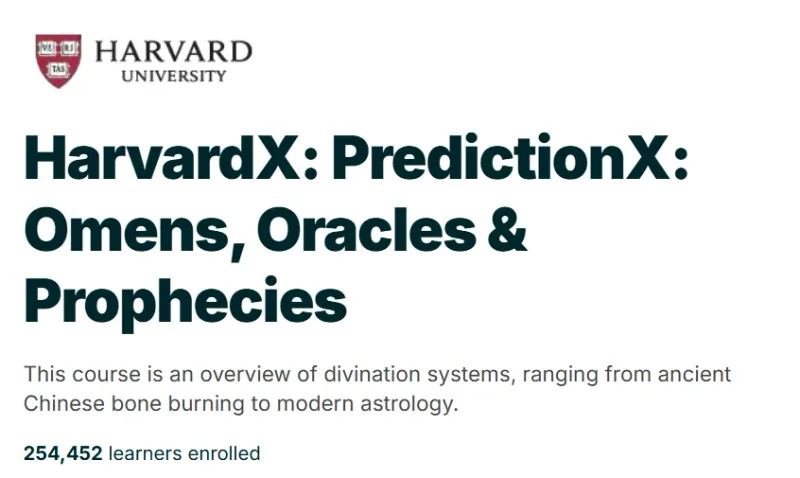
What will you learn in HarvardX: PredictionX: Omens, Oracles & Prophecies course
- This course explores how humans have tried to predict the future across cultures and historical periods.
- Learners will understand ancient practices such as divination, astrology, prophecy, and oracles.
- The course emphasizes the cultural, religious, and scientific contexts behind prediction systems.
- Students will examine how early forecasting methods evolved into modern probability, statistics, and data-driven prediction.
- Through historical case studies, participants will analyze why societies rely on prediction during times of uncertainty.
- By the end of the course, learners will gain insight into the intellectual evolution from mystical forecasting to modern predictive science.
Program Overview
Ancient Systems of Prediction
⏳ 2–3 Weeks
- Explore early divination practices in ancient civilizations.
- Understand the role of oracles and sacred prophecy.
- Analyze how prediction shaped political and religious decisions.
- Examine symbolic systems used to interpret the future.
Astrology, Astronomy, and Early Science
⏳ 2–3 Weeks
- Study how astrology influenced early scientific thought.
- Understand connections between celestial observation and forecasting.
- Explore medieval and Renaissance predictive traditions.
- Analyze how astronomy began separating from astrology.
Probability and the Birth of Modern Forecasting
⏳ 2–3 Weeks
- Learn how mathematical probability emerged.
- Understand the role of statistics in prediction.
- Explore risk assessment and decision-making models.
- Examine the transition from superstition to scientific reasoning.
Prediction in the Modern World
⏳ 2–3 Weeks
- Study modern forecasting tools in economics, weather, and health.
- Understand predictive modeling and data analysis basics.
- Analyze ethical and philosophical questions around prediction.
- Reflect on human behavior in uncertain environments.
Get certificate
Job Outlook
- While this course is humanities-focused, its themes connect to careers in history, philosophy, cultural studies, public policy, and data science communication.
- Professionals in research, academia, journalism, and public affairs benefit from understanding the historical foundations of predictive thinking.
- Knowledge of forecasting evolution also supports roles in risk analysis, economics, and strategic planning where prediction plays a central role.
- Human-centered perspectives on uncertainty are increasingly valuable in interdisciplinary fields combining data science and social sciences.
- This course is particularly useful for learners interested in the intersection of culture, science, and decision-making.