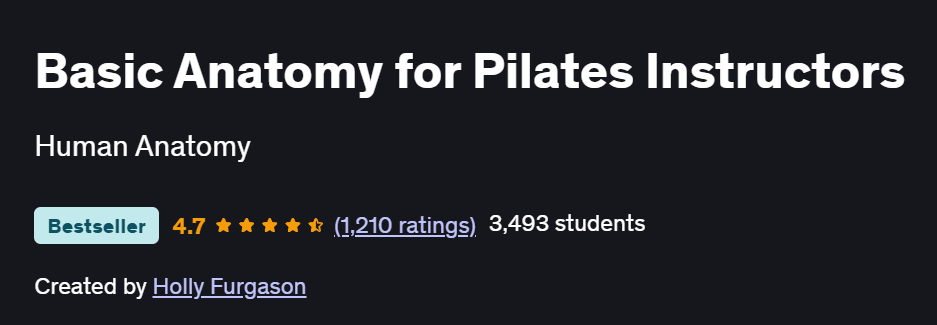
What will you in Basic Anatomy for Pilates Instructors Course
- Identify major bones, joints, and muscle groups relevant to Pilates
- Understand how anatomy influences movement patterns and posture
- Apply functional anatomy principles to design safe, effective Pilates exercises
- Recognize common injury mechanisms and modify movements accordingly
- Communicate anatomy concepts clearly to clients for better body awareness
Program Overview
Introduction & Course Foundations
⏳ 30 minutes
-
Why anatomy matters in Pilates instruction
-
Overview of course structure and learning objectives
Skeletal System Essentials
⏳ 45 minutes
-
Major bones and joint types involved in Pilates movements
-
Understanding spinal alignment and pelvic positioning
Muscular Anatomy & Function
⏳ 1 hour
-
Key muscle groups: core stabilizers, hip extensors, scapular movers
-
Agonist/antagonist relationships and movement control
Biomechanics & Movement Analysis
⏳ 45 minutes
-
Principles of leverage, torque, and joint loading
-
Analysing common Pilates exercises through an anatomical lens
Exercise Application & Modifications
⏳ 1 hour
-
Translating anatomy into cueing for exercises like the Roll-Up and Teaser
-
Modifying movements for postural imbalances and injury prevention
Injury Prevention & Safe Practice
⏳ 45 minutes
-
Identifying red-flags and contraindications in Pilates clients
-
Designing safe progression plans and corrective strategies
Program Design & Assessment
⏳ 30 minutes
-
Structuring sessions using anatomical priorities
-
Assessing client alignment, range of motion, and functional goals
Get certificate
Job Outlook
- Pilates instructors with solid anatomy knowledge are in high demand for studios, gyms, and rehabilitation settings
- Understanding anatomy enhances credibility, client safety, and retention
- Opens pathways to advanced certifications (e.g., Therapeutic Pilates, Pilates for Injuries)
- Valuable for fitness professionals, physical therapists, and movement coaches integrating Pilates
Explore More Learning Paths
Take your anatomy knowledge and Pilates instruction skills to the next level with these carefully selected programs designed to enhance your teaching and understanding of the human body.
Related Courses
-
Anatomy Specialization Course – Master the foundational concepts of human anatomy and understand how the body functions to support effective instruction.
-
Anatomy of the Chest, Neck, Abdomen, and Pelvis Course – Dive deeper into specific regions of the body, gaining precise knowledge that is essential for safe and effective Pilates teaching.
-
Easy Anatomy and Physiology Platinum Edition Course – Learn anatomy and physiology in a simplified, engaging way that reinforces practical application for instructors.
Related Reading
-
What Is Human Resource Management – Gain insights into structured management and organizational skills that can enhance your approach to client instruction and studio management.