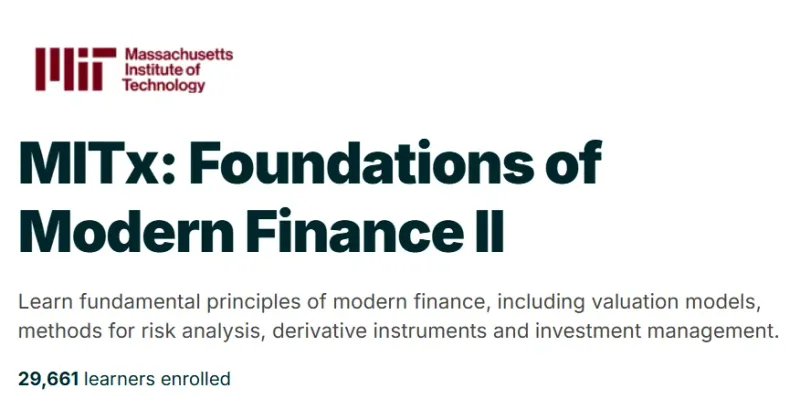
What will you learn in MITx: Foundations of Modern Finance II course
- This course provides an in-depth understanding of modern financial theory, focusing on asset pricing, portfolio management, and risk-return trade-offs.
- Learners will explore the Capital Asset Pricing Model (CAPM) and understand how systematic risk influences expected returns.
- The course emphasizes quantitative reasoning and analytical frameworks used in investment decision-making.
- Students will study diversification, efficient frontier theory, and portfolio optimization strategies.
Program Overview
Risk and Return Fundamentals
⏳ 3–4 Weeks
- In this section, you will examine the relationship between risk and expected return in financial markets.
- Understand systematic vs. unsystematic risk.
- Learn how diversification reduces portfolio risk.
- Explore variance, covariance, and correlation in asset returns.
Portfolio Theory and Optimization
⏳ 4–6 Weeks
- This section focuses on constructing efficient investment portfolios.
- Study the Efficient Frontier and mean-variance optimization.
- Learn how investors choose optimal portfolios based on risk preferences.
- Understand the role of diversification in maximizing returns.
Capital Asset Pricing Model (CAPM)
⏳ 4–6 Weeks
- Here, you will explore one of the core models in financial economics.
- Understand beta and market risk premium concepts.
- Learn how CAPM determines expected asset returns.
- Analyze the Security Market Line (SML) framework.
Applications and Advanced Topics
⏳ 3–4 Weeks
- The final section connects theory with practical investment strategy.
- Evaluate portfolio performance metrics.
- Understand market efficiency and behavioral finance considerations.
- Apply financial models to real-world investment scenarios.
Get certificate
Job Outlook
- Modern finance expertise is highly valued in investment banking, asset management, private equity, fintech, and corporate finance.
- Professionals skilled in portfolio management and asset pricing are in demand for roles such as Financial Analyst, Portfolio Manager, Investment Banker, and Quantitative Analyst.
- Entry-level financial analysts typically earn between $70K–$95K per year, while experienced portfolio managers and quantitative professionals can earn $120K–$200K+ depending on performance and firm size.
- Strong knowledge of CAPM and portfolio theory is essential for CFA candidates and finance professionals.
- This course strengthens preparation for advanced studies in financial engineering, quantitative finance, and capital markets.