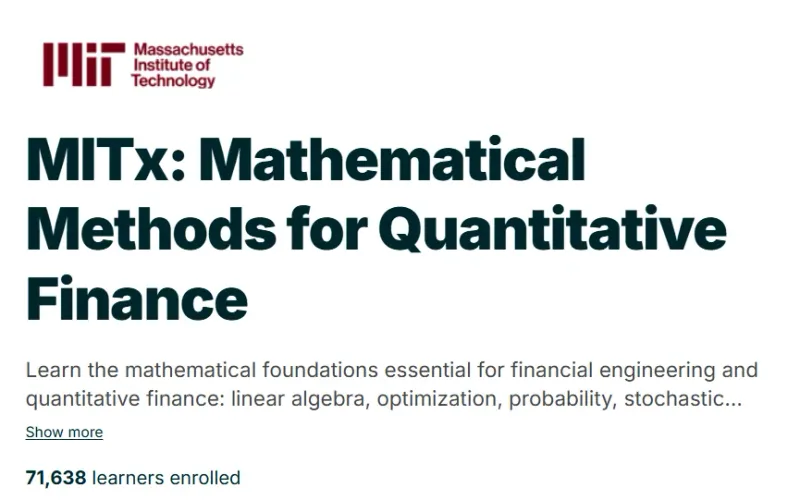
What will you learn in MITx: Mathematical Methods for Quantitative Finance course
-
Apply advanced mathematical tools used in quantitative finance.
-
Understand stochastic processes and their financial applications.
-
Work with differential equations in asset pricing models.
-
Analyze Brownian motion and Ito calculus fundamentals.
-
Apply probability theory to derivative pricing.
-
Build strong quantitative foundations for financial engineering careers.
Program Overview
Probability and Stochastic Processes
⏳ 4–5 weeks
-
Review probability theory essentials.
-
Study random variables and continuous-time processes.
-
Understand Brownian motion concepts.
Differential Equations in Finance
⏳ 4–5 weeks
-
Apply ordinary and partial differential equations.
-
Analyze models used in option pricing.
-
Solve financial modeling problems mathematically.
Ito Calculus and Financial Modeling
⏳ 4–5 weeks
-
Understand stochastic calculus fundamentals.
-
Apply Ito’s lemma in asset pricing.
-
Explore mathematical derivation of pricing models.
Applications in Derivatives and Risk Management
⏳ 3–4 weeks
-
Study Black-Scholes framework.
-
Analyze hedging and arbitrage principles.
-
Apply mathematical reasoning to risk modeling.
Get certificate
Job Outlook
-
Ideal for aspiring Quantitative Analysts (Quants) and Financial Engineers.
-
Valuable for careers in investment banking, hedge funds, and risk management.
-
Strong preparation for advanced finance graduate programs.
-
Prestigious MIT credential enhances credibility in quantitative finance fields.