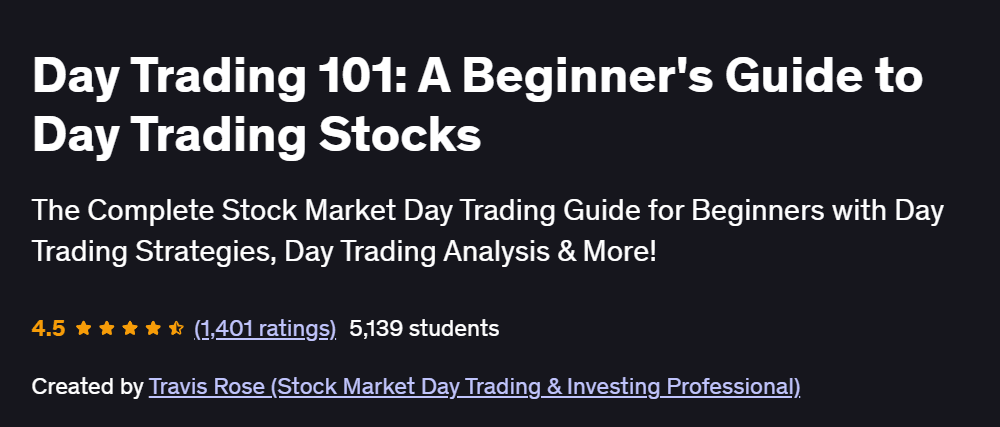
What will you in Day Trading 101: A Beginner’s Guide to Day Trading Stocks Course
-
Understand how the stock market operates and what causes price fluctuations.
-
Learn how to start day trading with no prior market experience.
-
Use simple technical and fundamental analysis strategies to profit in any market condition.
-
Create a trade plan to minimize risk while trading.
-
Identify and trade predictable chart patterns.
-
Control emotions and develop trading psychology.
Program Overview
Module 1: Introduction to Day Trading
⏳ 30 minutes
-
Overview of the stock market and day trading basics.
-
Understanding price fluctuations and market dynamics.
-
Setting up a trading account and choosing a broker.
Module 2: Technical Analysis Fundamentals
⏳ 45 minutes
-
Reading and interpreting stock charts.
-
Identifying candlestick patterns and chart formations.
-
Using technical indicators like moving averages and RSI.
Module 3: Trading Strategies and Techniques
⏳ 45 minutes
-
Developing a day trading strategy.
-
Understanding entry and exit points.
-
Implementing risk management techniques.
Module 4: Trading Psychology
⏳ 30 minutes
-
Recognizing emotional triggers in trading.
-
Techniques to maintain discipline and control over emotions.
-
Building a trader’s mindset for long-term success.
Module 5: Real-World Application
⏳ 30 minutes
-
Analyzing real trades and market scenarios.
-
Applying learned strategies in live market conditions.
-
Reviewing and learning from past trades.
Get certificate
Job Outlook
- Day trading offers opportunities for individuals seeking to generate income through short-term trades.
- While it can be profitable, it also carries significant risk and requires a strong understanding of the markets.
- Success in day trading often depends on discipline, strategy, and continuous learning.
Explore More Learning Paths
Boost your trading knowledge and technical skills with courses that teach stock trading fundamentals, algorithmic strategies, and Forex market essentials.
Related Courses
-
Machine Learning for Trading Specialization Course – Learn how to apply machine learning techniques to analyze financial markets and improve trading strategies.
-
Day Trading for Dummies – 1 Hour Beginner Course – Master the basics of day trading with simple, practical approaches for beginners.
-
Forex Trading: Your Complete Guide to Get Started Like a Pro Course – Explore currency markets, trading strategies, and risk management for Forex trading success.
Related Reading
Enhance your understanding of structured financial planning and wealth growth:
-
What Is Wealth Management? – Discover key strategies to manage and grow your financial assets effectively.