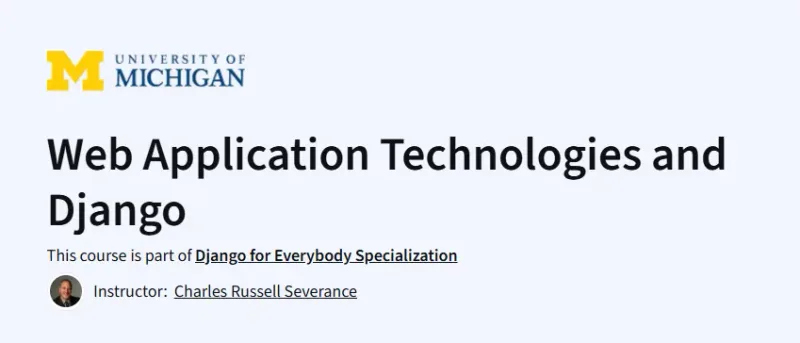
What will you learn in Web Application Technologies and Django Course
- Explain the basics of HTTP and how the request–response cycle works.
- Install and deploy a simple Django application on a cloud service.
- Build and style basic web pages using HTML and CSS within a Django project.
- Model data and perform CRUD operations through Django’s ORM and SQL.
Program Overview
Module 1: Introduction to Dynamic Web Content
⌛ 3 hours
• Topics: HTTP methods (GET, POST, Redirect), HTML fundamentals, server–client interaction.
• Hands-on: Build a simple HTML page served by Django, examine HTTP headers.
Module 2: Setting Up Django Projects
⌛ 4 hours
• Topics: Virtual environments, Django project/app structure, URL routing, view functions.
• Hands-on: Initialize a Django project, map URLs to views, render basic templates.
Module 3: Templates, Static Files & Styling
⌛ 4 hours
• Topics: Django template language, static file handling, integrating CSS, template inheritance.
• Hands-on: Create reusable templates, include and version static assets, style pages.
Module 4: Data Models & the ORM
⌛ 4 hours
• Topics: Defining models, migrations, model relationships (one-to-many, many-to-many), querying.
• Hands-on: Design a data schema, run migrations, perform CRUD operations via the Django shell.
Module 5: Deployment & Best Practices
⌛ 5 hours
• Topics: PythonAnywhere deployment, configuration settings, debugging, security basics, MVC in practice.
• Hands-on: Deploy your app to PythonAnywhere, test it live, implement basic security headers.
Get certificate
Job Outlook
• Strong demand for full-stack and back-end developers skilled in Django and Python.
• Roles such as Django Developer, Web Application Engineer, and Backend Engineer rely on these skills.
• Opportunities in startups, tech companies, and enterprises building data-driven web platforms.
• Mastery of deployment and web protocols enhances prospects in DevOps and site reliability engineering.
Explore More Learning Paths
Advance your web development expertise by mastering full-stack application development, backend frameworks, and modern web technologies with these curated courses.
Related Courses
-
Web Applications for Everybody Specialization Course – Learn to build dynamic web applications from scratch using HTML, CSS, JavaScript, and server-side programming.
-
Building Web Applications in PHP Course – Explore backend web development using PHP and database integration to create interactive web applications.
-
Building Web Applications with Go: Intermediate Level Course – Strengthen your backend programming skills using Go to develop scalable and efficient web applications.
Related Reading
-
What Is Management? – Understand the essentials of web development and the technologies behind building functional and interactive web applications.