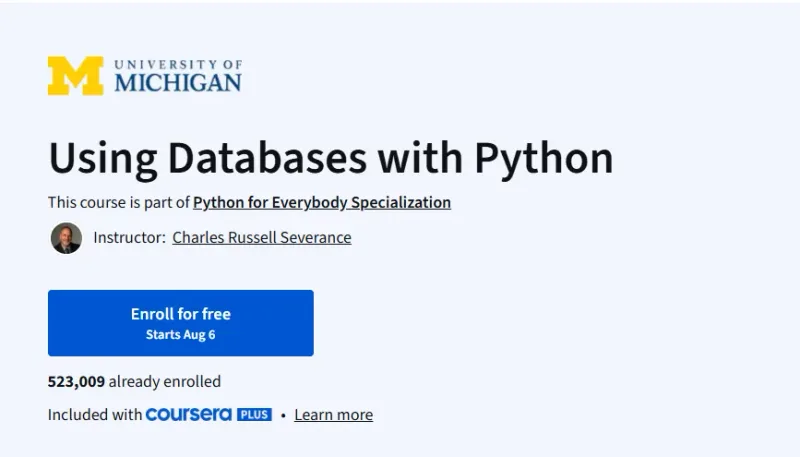
Using Databases with Python Course

Using Databases with Python Course Course

This course is a practical, beginner-friendly path to mastering relational databases with Python. Its mix of SQL fundamentals, ORM skills, and real-world testing makes it valuable for both aspiring de...

Explore This Course Quick Enroll Page
9.7/10 Highly Recommended

Using Databases with Python Course on Coursera — This course is a practical, beginner-friendly path to mastering relational databases with Python. Its mix of SQL fundamentals, ORM skills, and real-world testing makes it valuable for both aspiring developers and analysts.

Pros

  • Clear explanations for both SQL and ORM concepts.
  • Step-by-step practice with SQLite and SQLAlchemy.
  • Hands-on coding for every concept.

Cons

  • Limited coverage of advanced database performance tuning.
  • No exposure to cloud-based or distributed databases.

Using Databases with Python Course Course

Platform: Coursera

Instructor: University of Michigan

What will you learn in Using Databases with Python Course

  • How to design and manage relational databases in Python.

  • Using SQLAlchemy to connect Python applications with databases.

  • Writing and optimizing complex SQL queries.

​​​​​​​​​​

  • Handling many-to-many relationships and database normalization.

  • Testing and integrating database operations into real-world Python projects.

Program Overview

Module 1: Introduction to Relational Databases
⌛ 1 week

  • Topics: Understanding database architecture, relational models, and primary/foreign keys.

  • Hands-on: Set up SQLite and connect it with Python.

Module 2: SQL Basics and Queries
⌛ 1 week

  • Topics: Writing SELECT, INSERT, UPDATE, DELETE queries; filtering and sorting data.

  • Hands-on: Practice basic SQL commands in SQLite through Python scripts.

Module 3: Advanced SQL & Joins
⌛ 1 week

  • Topics: INNER JOIN, LEFT JOIN, RIGHT JOIN, and multi-table queries.

  • Hands-on: Build reports combining data from multiple tables.

Module 4: SQLAlchemy ORM
⌛ 1 week

  • Topics: Using SQLAlchemy for object-relational mapping, defining models, and CRUD operations.

  • Hands-on: Map Python classes to database tables and perform operations.

Module 5: Relationship Modeling & Normalization
⌛ 1 week

  • Topics: Relationship modeling, complex queries, and database normalization.

  • Hands-on: Implement many-to-many relationships in SQLAlchemy and test with Python scripts.

Get certificate

Job Outlook

  • Relational database skills are in high demand across industries.

  • Career growth in backend development, data engineering, and analytics.

  • Average salary for Python database developers: $80,000–$110,000/year.

  • Opportunities for freelance database design and maintenance work.

Explore More Learning Paths
Expand your Python programming expertise by mastering database integration, SQL, and data management to handle real-world applications and data-driven projects.

Related Courses

Related Reading

  • What Is Data Management? – Understand the principles of managing and organizing data efficiently for business and technical applications.
FAQs

Will I gain skills in integrating Python with multiple database systems?
Learn to connect Python to SQLite, MySQL, or PostgreSQL. Handle database errors and exceptions programmatically. Apply queries to manipulate and analyze real datasets. Build Python scripts that interact with databases for automation. Skills directly transferable to backend development, analytics, and data-driven applications.
How long will it take to complete the course and practice database projects?
Typically 4–6 weeks with self-paced learning. Covers connecting to databases, performing queries, and managing data transactions. Includes hands-on exercises and mini-projects. Flexible schedule suitable for learners balancing work or studies. Ensures practical experience through project-based learning.
Can this course help me in data analysis or backend development roles?
Builds skills for Data Analyst, Python Developer, and Backend Engineer roles. Prepares learners to automate data storage, retrieval, and reporting tasks. Teaches best practices for database connections and queries in Python. Useful for web applications, dashboards, and data pipelines. Enhances portfolio projects with real database integration experience.
Will I learn to perform CRUD operations using Python?
Covers INSERT, SELECT, UPDATE, and DELETE commands through Python. Teaches querying and filtering data programmatically. Includes practice exercises using real-world datasets. Prepares learners to interact with databases in applications and scripts. Reinforces data integrity and transaction management principles.
Do I need prior Python or SQL experience to take this course?
Basic Python knowledge recommended; SQL familiarity is helpful but not mandatory. Introduces connecting Python with relational databases using libraries like sqlite3 or SQLAlchemy. Includes hands-on exercises for CRUD operations. Suitable for beginners aiming to combine Python programming with database management. Prepares learners for backend development or data-driven projects.

Similar Courses

Other courses in Computer Science Courses