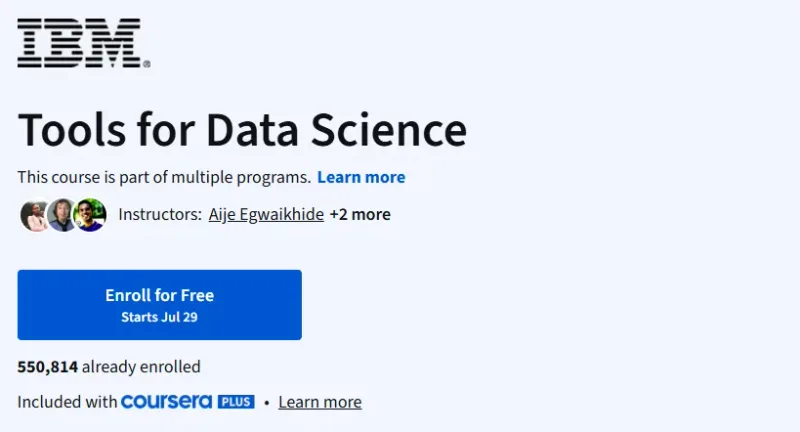
Tools for Data Science Course

Tools for Data Science Course Course

A strong foundational course that introduces beginners to essential tools in the data science workflow. It balances tool familiarity with hands-on activities and practical exposure. ...

Explore This Course
9.8/10 Highly Recommended

Tools for Data Science Course on Coursera — A strong foundational course that introduces beginners to essential tools in the data science workflow. It balances tool familiarity with hands-on activities and practical exposure.

Pros

  • Great for absolute beginners to data science
  • Covers a variety of industry-standard tools
  • Practical notebook-based assignments

Cons

  • Surface-level exposure to tools—no deep dive
  • May require some extra self-study to grasp Git and RStudio fully

Tools for Data Science Course Course

Platform: Coursera

What will you learn in Tools for Data Science Course

  • Identify and use the most common open-source tools in data science.

  • Navigate and perform basic operations using Jupyter Notebooks and RStudio.

​​​​​​​​​​

  • Work with cloud-based tools like Watson Studio.

  • Understand how different tools integrate into the data science lifecycle.

Program Overview

Module 1: Introduction to Open Source Tools

⏱️ 1 week

  • Topics: Overview of data science tools, open source philosophy

  • Hands-on: Explore tool ecosystems used in the field (e.g., Python, R, Git)

Module 2: Jupyter Notebooks and JupyterLab

⏱️ 1 week

  • Topics: Working with Jupyter Notebook and JupyterLab

  • Hands-on: Run basic code cells, markdown, and outputs in notebooks

Module 3: RStudio and GitHub

⏱️ 1 week

  • Topics: Introduction to RStudio, Git, and GitHub basics

  • Hands-on: Create R scripts, clone repositories, and make commits

Module 4: IBM Watson Studio

⏱️ 1 week

  • Topics: IBM Cloud, Watson Studio environment setup

  • Hands-on: Build a data science project workspace in Watson Studio

Module 5: Final Assignment

⏱️ 1 week

  • Topics: Integration of learned tools into a real-world scenario

  • Hands-on: Complete a mini-project using various tools introduced

Get certificate

Job Outlook

  • Proficiency in open-source tools like GitHub, Jupyter, and RStudio is essential for entry-level data science roles.

  • Job titles include Data Analyst, Junior Data Scientist, and AI Developer.

  • Strong demand in finance, tech, and healthcare industries.

  • Median salaries for data science roles range from $70K–$120K depending on experience and geography.

Explore More Learning Paths

Build deeper confidence in your data science journey with these curated programs designed to expand your technical toolkit, analytical thinking, and hands-on project experience.

Related Courses

Related Reading

Gain deeper insight into how project management drives real-world success:

FAQs

How much time should I dedicate weekly to complete the course effectively?
Estimated completion is around 3–5 weeks at a part-time pace. Weekly effort of 3–4 hours is generally sufficient for lectures and hands-on exercises. Regular practice ensures learners become comfortable using each tool. Revisiting exercises or experimenting with additional datasets may require extra time. Consistent engagement helps learners gain confidence in professional data science workflows.
Can this course help me pursue a career in data science?
Provides foundational exposure to tools commonly used by data scientists. Learners gain skills applicable to data wrangling, visualization, and analysis tasks. Completing the course strengthens resumes and portfolios for entry-level positions. Knowledge of tools helps in pursuing further specialized courses in data science. Hands-on practice prepares learners for internships or practical projects.
Will I gain hands-on experience using these tools?
The course includes guided exercises to practice each tool. Learners work on small projects to simulate real data science tasks. Hands-on labs help learners understand tool functionalities and workflows. Step-by-step examples ensure beginners can follow along confidently. Practical exercises help learners build familiarity with professional data science environments.
Which data science tools will I learn in this course?
The course introduces popular tools like Jupyter Notebooks, Git, and GitHub. Learners get exposure to Python and R environments for data analysis. Data visualization and data manipulation tools are also demonstrated. Emphasis is placed on practical usage and workflow integration. Skills learned are transferable to real-world data science projects.
Do I need prior knowledge of programming or data science to take this course?
The course is beginner-friendly and assumes no prior programming experience. Basic computer literacy helps, but all tools are introduced step-by-step. Learners are guided through installation and setup of data science tools. Hands-on exercises allow practice without prior technical background. Supplementary tutorials can accelerate understanding for complete beginners.

Similar Courses

Other courses in Computer Science Courses