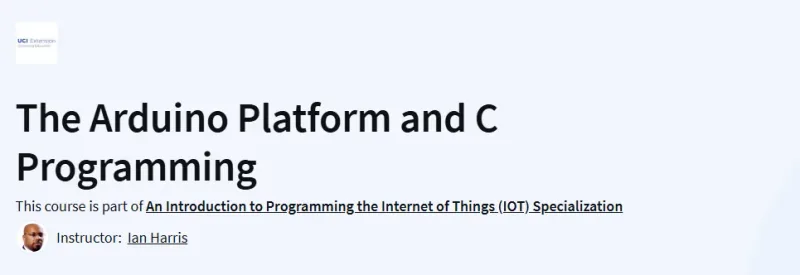
What will you in the The Arduino Platform and C Programming Course
-
The basics of Arduino hardware and its I/O capabilities.
-
How to write C code to control digital and analog signals.
-
How to interface sensors and actuators with Arduino.
-
Key programming concepts such as conditionals, loops, and functions as applied to embedded systems.
Program Overview
1. Introduction to Arduino and Embedded Systems
⏱ Duration: 1 week
-
Overview of embedded systems and the role of Arduino.
-
Introduction to Arduino hardware components and IDE.
-
Uploading your first sketch to the board.
2. C Programming Basics for Arduino
⏱ Duration: 1 week
-
Writing basic C code for microcontroller environments.
-
Understanding data types, operators, and control structures.
-
Using functions and modular programming practices.
3. Digital and Analog I/O
⏱ Duration: 1 week
-
Controlling LEDs, buttons, and buzzers using digital pins.
-
Reading analog signals using sensors and the ADC.
-
Pulse-width modulation (PWM) for dimming LEDs and controlling servos.
4. Sensor and Actuator Integration
⏱ Duration: 1 week
-
Interfacing common components like temperature sensors and motion detectors.
-
Capturing input data and acting upon real-world changes.
-
Mini-project: Create an interactive circuit using Arduino.
Get certificate
Job Outlook
-
Embedded systems and IoT roles are in high demand across industries.
-
Skills in microcontroller programming open doors to hardware engineering and robotics roles.
-
Great foundation for further study in electrical engineering, hardware prototyping, and product development.
-
Ideal for hobbyists and engineers seeking to develop hardware-software integration skills.
Explore More Learning Paths
Advance your skills in embedded systems, microcontroller programming, and hardware prototyping with these hand-picked courses designed to help you master the Arduino ecosystem.
Related Courses
-
Interfacing with the Arduino Course – Learn how to connect sensors, actuators, and communication modules to Arduino to build more advanced and interactive hardware projects.
-
Arduino for Beginners 2025 Complete Course – Start from the basics and quickly gain hands-on experience with circuits, coding, and real-world Arduino applications.
-
Arduino Step-by-Step: Getting Started Course – Build a strong introductory foundation in electronics and Arduino development through structured, easy-to-follow learning modules.
Related Reading
Gain deeper insight into how project management drives real-world success:
-
What Is Project Management? – Understand the core project execution principles that guide successful engineering and hardware development initiatives.