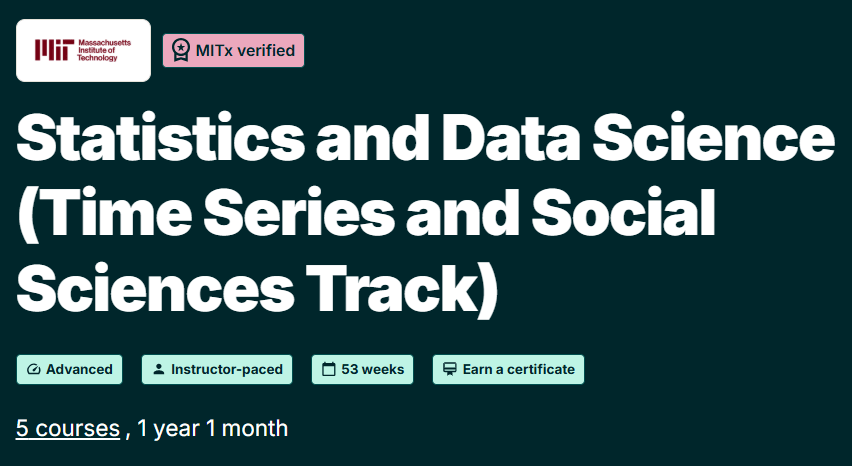
What will you learn in Statistics and Data Science (Time Series and Social Sciences Track) course
- This MicroMasters® track combines advanced statistical training with specialized focus on time series analysis and social science applications.
- Learners will develop a strong foundation in probability, statistical inference, and regression modeling.
- The program emphasizes time-dependent data analysis, including forecasting, ARIMA models, and intervention analysis.
- Students will explore econometric methods for policy evaluation and causal inference in dynamic systems.
- Advanced coursework strengthens understanding of stochastic processes, model diagnostics, and predictive analytics.
- By completing this track, participants gain the expertise required for careers in quantitative research, econometrics, financial forecasting, and policy analytics.
Program Overview
Probability and Statistical Foundations
⏳ 8–10 Weeks
- Understand random variables and probability distributions.
- Learn hypothesis testing and confidence intervals.
- Build mathematical intuition for statistical inference.
- Develop a solid base for advanced modeling techniques.
Regression and Econometrics
⏳ 8–10 Weeks
- Study linear and logistic regression models.
- Understand causal inference methods for policy evaluation.
- Learn econometric modeling techniques.
- Apply statistical tools to social and economic datasets.
Time Series Analysis
⏳ 8–10 Weeks
- Explore AR, MA, and ARIMA models.
- Understand stationarity, seasonality, and autocorrelation.
- Study forecasting techniques and structural breaks.
- Apply intervention models to evaluate policy or market events.
Capstone Examination
⏳ Final Assessment
- Complete a comprehensive proctored exam covering all core areas.
- Earn the MITx MicroMasters® credential upon successful completion.
Get certificate
Job Outlook
- This track is highly valuable for professionals working in economics, finance, public policy, and research institutions.
- Roles such as Econometrician, Quantitative Analyst, Policy Researcher, Financial Forecaster, and Data Scientist require strong time series and causal modeling skills.
- Entry-level quantitative professionals typically earn between $80K–$100K per year, while experienced econometricians and analysts can earn $120K–$170K+ depending on industry and specialization.
- Time series expertise is especially critical in macroeconomic analysis, stock market forecasting, demand planning, and government policy modeling.
- This program also strengthens applications for advanced master’s or PhD programs in econometrics, data science, and applied economics.