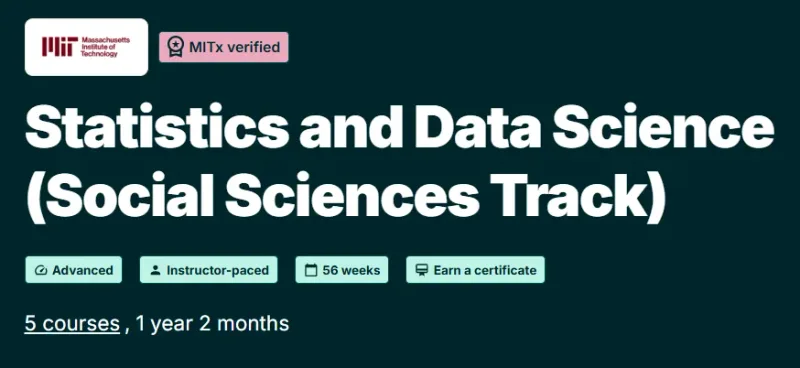
What will you learn in Statistics and Data Science (Social Sciences Track) course
- This MicroMasters® Social Sciences Track combines rigorous statistical training with applications tailored to economics, public policy, behavioral science, and social research.
- Learners will build strong foundations in probability, statistical inference, and regression modeling with emphasis on real-world social datasets.
- The program emphasizes causal inference techniques used to evaluate policies, interventions, and social programs.
- Students will explore econometrics, experimental design, and observational data analysis.
- Advanced modules strengthen skills in machine learning methods relevant to social sciences research.
- By completing this track, participants develop analytical expertise suited for policy analysis, research institutions, consulting, and academia.
Program Overview
Probability and Statistical Foundations
⏳ 8–10 Weeks
- Understand random variables and probability distributions.
- Study hypothesis testing and confidence intervals.
- Learn sampling theory and statistical reasoning.
- Build a strong quantitative base for social data analysis.
Regression and Econometrics
⏳ 8–10 Weeks
- Explore linear and logistic regression models.
- Understand causal inference and policy evaluation methods.
- Study model assumptions and diagnostic techniques.
- Apply econometric tools to real-world social datasets.
Data Analysis and Machine Learning Applications
⏳ 8–10 Weeks
- Learn supervised learning methods for classification and prediction.
- Understand model validation and performance metrics.
- Apply machine learning techniques to social and economic data.
- Interpret results for policy and research decisions.
Capstone Examination
⏳ Final Assessment
- Complete a comprehensive proctored exam to validate mastery.
- Earn the MITx MicroMasters® credential upon successful completion.
Get certificate
Job Outlook
- The Social Sciences Track is ideal for professionals pursuing careers in policy analysis, economic research, social impact evaluation, and academic research.
- Roles such as Policy Analyst, Economist, Data Scientist (Public Sector), Research Analyst, and Social Data Consultant require strong statistical and analytical skills.
- Entry-level policy analysts and research professionals typically earn between $70K–$95K per year, while experienced economists and data-driven consultants can earn $110K–$160K+ depending on organization and expertise.
- Governments, NGOs, research institutions, and international organizations increasingly rely on data-driven decision-making and evidence-based policies.
- This program also strengthens applications for graduate degrees in economics, public policy, political science, and data science.