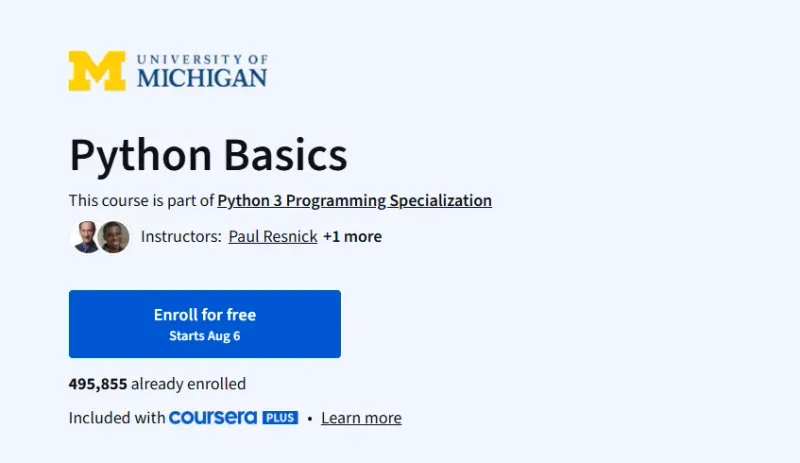
Python Basics Course

Python Basics Course Course

This course is a solid entry point into Python for complete beginners. It offers a structured approach with progressive learning, building from basic syntax to practical problem-solving. The exercises...

Explore This Course Quick Enroll Page
9.7/10 Highly Recommended

Python Basics Course on Coursera — This course is a solid entry point into Python for complete beginners. It offers a structured approach with progressive learning, building from basic syntax to practical problem-solving. The exercises are beginner-friendly yet provide enough challenge to ensure skill retention.

Pros

  • Clear and concise explanations.
  • Beginner-friendly pace.
  • Practical coding exercises for hands-on learning.

Cons

  • May feel slow for those with prior coding experience.
  • Limited coverage of advanced topics.

Python Basics Course Course

Platform: Coursera

Instructor: University of Michigan

What will you learn in Python Basics Course

  • Understand Python syntax, variables, and data types.
  • Use conditional statements, loops, and functions to write efficient code.

​​​​​​​​​​

  • Work with lists, dictionaries, and tuples for data storage and manipulation.
  • Apply Python basics to solve real-world problems.

Program Overview

Module 1: Python Basics
⌛ Duration: 1 week

  • Topics: Python syntax, expressions, variables, and simple input/output.

  • Hands-on: Write simple programs to perform calculations and handle user input.

Module 2: Data Structures
⌛ Duration: 1 week

  • Topics: Lists, tuples, and dictionaries in Python.

  • Hands-on: Create and manipulate collections to organize and process data.

Module 3: Conditional Execution
⌛ Duration: 1 week

  • Topics: if, elif, and else statements for decision-making.

  • Hands-on: Implement logic-based programs using conditionals.

Module 4: Loops and Iteration
⌛ Duration: 1 week

  • Topics: for loops, while loops, and iteration over collections.

  • Hands-on: Automate repetitive tasks and process multiple data points efficiently.

Module 5: Functions
⌛ Duration: 1 week

  • Topics: Defining and calling functions, arguments, and return values.

  • Hands-on: Write reusable functions to simplify code and avoid redundancy.

Get certificate

Job Outlook

  • High demand for Python programmers in data analysis, automation, and software development.

  • Entry-level roles in software engineering, QA, and scripting.

  • Average salary for Python developers: $70,000–$120,000/year.

  • Opportunities to freelance in automation and data manipulation tasks.

Explore More Learning Paths
Strengthen your foundational Python skills and progress toward more advanced programming and data analysis with these carefully selected courses.

Related Courses

Related Reading

FAQs

Will I gain skills in writing reusable functions and controlling program flow?
Learn to define and call functions with arguments and return values. Practice conditional statements (if, elif, else) and loops (for, while). Write reusable code to avoid redundancy and improve efficiency. Apply logic to automate repetitive tasks and solve real problems. Skills are directly transferable to software development and data manipulation tasks.
How long will it take to complete the course and practice coding exercises?
Duration: 5 weeks (1 week per module). Modules include Python basics, data structures, conditionals, loops, and functions. Self-paced format allows flexible scheduling. Hands-on exercises reinforce learning for each module. Suitable for learners seeking structured and beginner-friendly programming training.
Can this course help me start a career in software development or data-related roles?
Prepares learners for roles in software development, data analysis, and automation. Builds problem-solving skills applicable to programming jobs. Provides practical coding exercises to strengthen a portfolio. Supports further learning in advanced Python and data science courses. Enhances employability in entry-level technical positions.
Will I learn to work with Python data structures like lists and dictionaries?
Covers lists, tuples, and dictionaries for data storage and manipulation. Teaches creating, accessing, and updating collections. Includes exercises to practice organizing and processing data. Prepares learners for real-world programming tasks. Builds foundational knowledge for advanced Python topics.
Do I need prior programming experience to take this course?
No prior coding experience required; designed for beginners. Covers Python syntax, variables, and basic expressions. Includes hands-on exercises for writing simple programs. Focuses on problem-solving using Python fundamentals. Ideal for learners aiming to build a solid foundation in programming.

Similar Courses

Other courses in Computer Science Courses