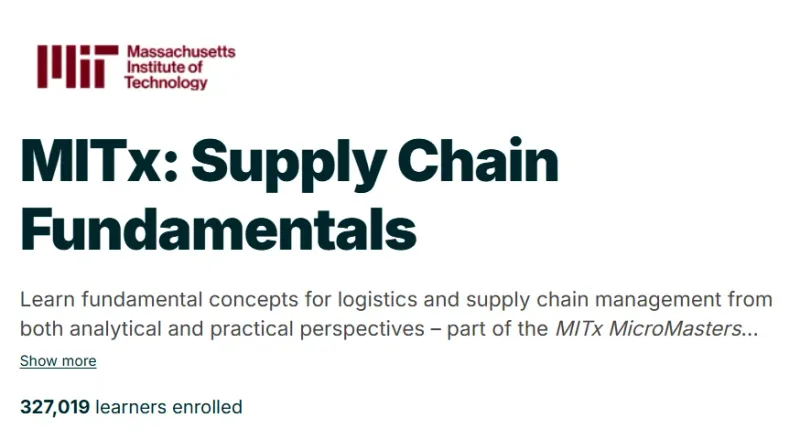
What will you learn in MITx: Supply Chain Fundamentals course
- This course provides a comprehensive introduction to supply chain management, focusing on the flow of goods, information, and finances across global networks.
- Learners will understand how supply chains are structured and how strategic decisions impact cost, service level, and risk.
- The course emphasizes analytical frameworks used to design, evaluate, and optimize supply chain systems.
- Students will explore demand forecasting, inventory management, transportation planning, and network design principles.
- Real-world case studies demonstrate how companies manage supply chain disruptions, globalization challenges, and operational trade-offs.
- By the end of the course, participants will gain a strong foundation in supply chain strategy and operational decision-making.
Program Overview
Introduction to Supply Chain Systems
⏳ 3–4 Weeks
- In this section, you will explore the structure and components of supply chains.
- Understand suppliers, manufacturers, distributors, retailers, and customers.
- Learn about material, information, and financial flows.
- Develop insight into supply chain performance metrics.
Demand Forecasting and Planning
⏳ 4–6 Weeks
- This section focuses on predicting demand and planning operations.
- Learn quantitative forecasting techniques.
- Understand uncertainty and variability in demand.
- Analyze the impact of forecasting accuracy on inventory and service levels.
Inventory Management and Optimization
⏳ 4–6 Weeks
- Here, you will study strategies to balance cost and service efficiency.
- Understand Economic Order Quantity (EOQ) models.
- Learn safety stock calculations and risk pooling concepts.
- Analyze trade-offs between holding costs and stockouts.
Network Design and Transportation
⏳ 3–4 Weeks
- The final section explores strategic network decisions.
- Learn how facility location affects cost and service.
- Understand transportation modes and cost structures.
- Apply optimization techniques for global supply chain design.
Get certificate
Job Outlook
- Supply chain management is a high-demand field across industries such as retail, manufacturing, e-commerce, pharmaceuticals, and logistics.
- Professionals with supply chain expertise are sought after for roles like Supply Chain Analyst, Operations Manager, Logistics Planner, and Procurement Specialist.
- Entry-level supply chain analysts typically earn between $60K–$85K per year, while experienced supply chain managers can earn $95K–$130K+ depending on industry and region.
- Globalization, e-commerce growth, and digital transformation have significantly increased the demand for skilled supply chain professionals.
- This course provides strong preparation for advanced certifications and graduate studies in operations and supply chain management.