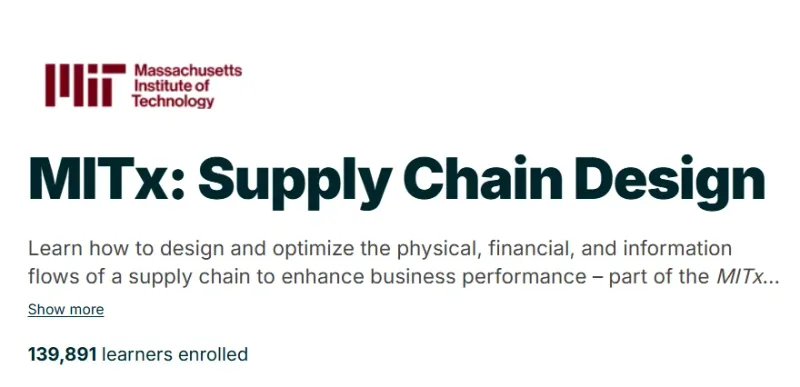
What will you learn in MITx: Supply Chain Design course
- This course provides an in-depth understanding of strategic supply chain design and network optimization.
- Learners will understand how to design global supply chain networks that balance cost, service level, and risk.
- The course emphasizes analytical modeling techniques used to determine facility locations, transportation flows, and capacity planning.
- Students will explore trade-offs between centralized and decentralized distribution systems.
- Real-world case studies demonstrate how companies redesign supply chains to improve efficiency and resilience.
- By the end of the course, participants will gain quantitative and strategic skills required to build competitive supply chain networks.
Program Overview
Foundations of Supply Chain Network Design
⏳ 3–4 Weeks
- Understand the structure of global supply chain networks.
- Learn about suppliers, production facilities, warehouses, and distribution centers.
- Study cost drivers and service-level considerations.
- Develop system-level thinking for network configuration.
Facility Location and Capacity Planning
⏳ 4–6 Weeks
- Learn quantitative models for facility location decisions.
- Understand capacity constraints and investment trade-offs.
- Analyze fixed and variable cost structures.
- Apply optimization techniques to determine ideal network layouts.
Transportation and Flow Optimization
⏳ 4–6 Weeks
- Study transportation modes and cost trade-offs.
- Understand flow optimization and routing strategies.
- Learn about demand allocation across facilities.
- Evaluate global logistics performance metrics.
Risk Management and Strategic Resilience
⏳ 3–4 Weeks
- Explore supply chain risk factors and disruptions.
- Understand strategies for redundancy and flexibility.
- Analyze the impact of uncertainty on network design.
- Apply scenario analysis for strategic planning.
Get certificate
Job Outlook
- Supply chain design expertise is highly valued in industries such as manufacturing, retail, e-commerce, pharmaceuticals, and global logistics.
- Professionals with network optimization skills are sought after for roles like Supply Chain Design Analyst, Logistics Strategist, Operations Consultant, and Network Planning Manager.
- Entry-level supply chain analysts typically earn between $70K–$95K per year, while experienced supply chain strategists and consultants can earn $110K–$150K+ depending on industry and region.
- As globalization and e-commerce expand, companies increasingly invest in optimized and resilient supply chain networks.
- This course provides strong preparation for advanced certifications and leadership roles in operations and supply chain strategy.