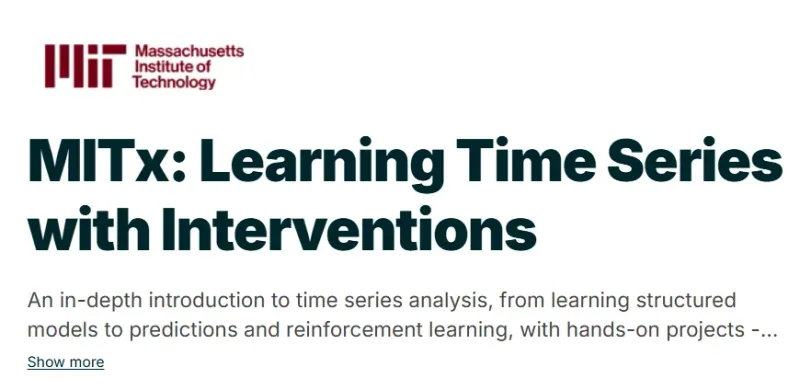
What will you learn in MITx: Learning Time Series with Interventions course
- This course provides a rigorous introduction to time series analysis with a special focus on intervention modeling and causal impact evaluation.
- Learners will understand how time-dependent data behaves, including trends, seasonality, autocorrelation, and noise.
- The course emphasizes statistical modeling techniques used to measure the impact of policy changes, market events, or interventions over time.
- Students will explore ARIMA models, forecasting techniques, and regression-based approaches for time series data.
Program Overview
Foundations of Time Series Analysis
⏳ 3–4 Weeks
- In this section, you will explore the fundamental characteristics of time series data.
- Understand stationarity, trends, and seasonal patterns.
- Learn about autocorrelation and partial autocorrelation functions.
- Develop intuition for stochastic processes in time-dependent datasets.
ARIMA and Forecasting Models
⏳ 4–6 Weeks
- This section focuses on predictive modeling techniques.
- Learn AR, MA, and ARIMA modeling frameworks.
- Understand model identification, parameter estimation, and diagnostics.
- Apply forecasting methods to real-world datasets.
Intervention and Impact Analysis
⏳ 4–6 Weeks
- Here, you will study how to measure the effect of specific events or policy changes.
- Learn how to incorporate intervention variables into time series models.
- Analyze structural breaks and regime shifts.
- Evaluate causal impact using statistical inference techniques.
Advanced Applications and Case Studies
⏳ 3–4 Weeks
- The final section connects theory with practical implementation.
- Apply time series models in finance, economics, and operations.
- Interpret model outputs for strategic decision-making.
- Understand limitations and assumptions of time series modeling.
Get certificate
Job Outlook
- Time series expertise is highly valued in finance, economics, supply chain analytics, healthcare analytics, and machine learning.
- Professionals skilled in forecasting and causal impact analysis are in demand for roles such as Data Scientist, Quantitative Analyst, Economist, and Business Intelligence Analyst.
- Entry-level data analysts typically earn between $70K–$95K per year, while experienced data scientists and quantitative professionals can earn $110K–$160K+ depending on expertise and industry.
- Time series modeling is essential for stock price forecasting, demand planning, economic policy analysis, and AI-driven predictive systems.
- This course provides strong preparation for advanced studies in data science, econometrics, machine learning, and quantitative finance.