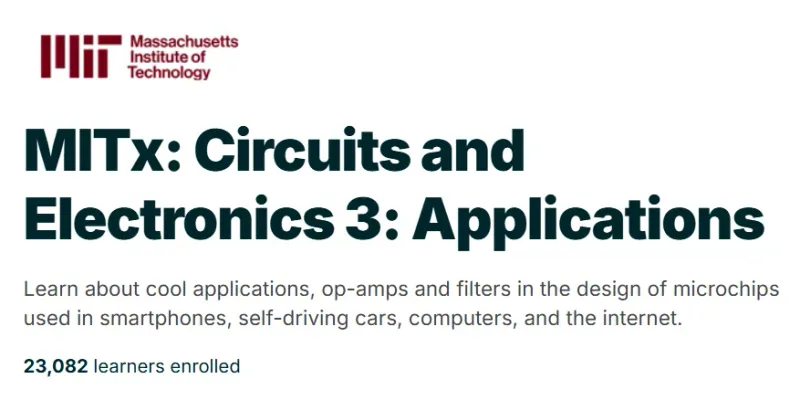
What will you learn in MITx: Circuits and Electronics 3: Applications course
- This course is the advanced continuation of the MIT Circuits and Electronics series, focusing on real-world applications of electronic circuit design.
- Learners will explore how analog and digital circuits are integrated into practical systems such as communication devices, signal processing units, and computing hardware.
- The course emphasizes system-level thinking, helping students understand how individual components interact within larger electronic architectures.
- Students will study nonlinear circuits, feedback systems, and advanced amplifier applications.
- Real-world engineering scenarios demonstrate how to design reliable, high-performance electronic systems.
- By the end of the course, participants will gain advanced analytical and design skills aligned with professional electrical engineering standards.
Program Overview
Advanced Amplifier Applications
⏳ 3–4 Weeks
- In this section, you will deepen your understanding of amplifier design.
- Analyze multi-stage amplifiers and cascaded systems.
- Understand feedback mechanisms and stability considerations.
- Apply performance optimization techniques in analog circuits.
Nonlinear and Dynamic Circuits
⏳ 4–6 Weeks
- This section focuses on circuits beyond linear approximations.
- Study nonlinear behavior in semiconductor devices.
- Understand switching circuits and transient responses.
- Analyze dynamic system behavior under varying signal conditions.
Integrated Circuit Applications
⏳ 4–6 Weeks
- Here, you will explore how circuits are implemented in integrated form.
- Understand scaling challenges in IC design.
- Learn how analog and digital components coexist within chips.
- Analyze power consumption, speed, and reliability trade-offs.
System-Level Design and Performance
⏳ 3–4 Weeks
- The final section connects component-level analysis to full-system performance.
- Evaluate circuit efficiency in communication and computing systems.
- Understand signal integrity and noise considerations.
- Apply engineering judgment in designing practical electronic systems.
Get certificate
Job Outlook
- Advanced circuit design expertise is essential in industries such as semiconductor manufacturing, telecommunications, embedded systems, aerospace, and consumer electronics.
- Professionals with system-level electronics knowledge are in demand for roles like Electronics Design Engineer, VLSI Engineer, Hardware Architect, and RF Systems Engineer.
- Entry-level hardware engineers typically earn between $75K–$100K per year, while experienced IC designers and system architects can earn $120K–$160K+ depending on specialization and industry.
- Strong electronics application knowledge is crucial for chip design, IoT hardware, 5G infrastructure, and high-performance computing systems.
- This course significantly strengthens preparation for graduate-level electrical engineering and semiconductor industry careers.