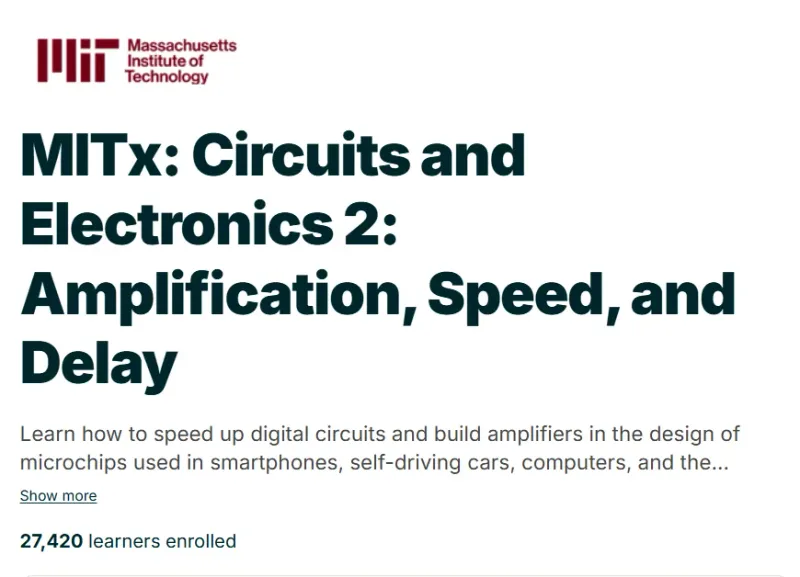
What will you learn in MITx: Circuits and Electronics 2: Amplification, Speed, and Delay course
- This course builds on foundational circuit analysis and explores the principles of electronic amplification, high-speed circuits, and signal delay.
- Learners will understand how transistors function as amplifiers and switches in modern electronic systems.
- The course emphasizes frequency response, small-signal modeling, and the behavior of circuits at higher speeds.
- Students will explore concepts such as gain, bandwidth, time delay, and signal propagation in analog and digital systems.
- Advanced analytical techniques help learners evaluate circuit performance in real-world communication and computing applications.
- By the end of the course, participants will gain deeper insight into the design and analysis of amplifiers and high-speed electronic circuits.
Program Overview
Transistor Fundamentals and Amplification
⏳ 3–4 Weeks
- In this section, you will study the physics and operation of MOSFETs and BJTs.
- Learn how transistors are used to build amplifiers.
- Understand biasing techniques and small-signal models.
- Analyze gain and operating point stability.
Frequency Response and Bandwidth
⏳ 4–6 Weeks
- This section focuses on circuit behavior at different frequencies.
- Learn about capacitive effects and their influence on signal amplification.
- Understand cutoff frequencies and bandwidth limitations.
- Analyze Bode plots and frequency-domain representations.
Speed, Delay, and Dynamic Behavior
⏳ 4–6 Weeks
- Here, you will examine high-speed performance in electronic systems.
- Study propagation delay and switching characteristics.
- Understand RC time constants in digital circuits.
- Analyze trade-offs between speed, power, and reliability.
Applications in Modern Electronics
⏳ 3–4 Weeks
- The final section connects theory with practical system design.
- Explore amplifier design for communication systems.
- Understand signal integrity in digital logic circuits.
- Apply advanced circuit analysis to real-world electronic problems.
Get certificate
Job Outlook
- Advanced circuit and amplifier knowledge is critical in industries such as semiconductor design, telecommunications, embedded systems, and consumer electronics.
- Professionals skilled in high-speed electronics are in demand for roles like Electronics Engineer, Hardware Design Engineer, RF Engineer, and VLSI Designer.
- Entry-level electronics engineers typically earn between $70K–$95K per year, while experienced hardware and semiconductor engineers can earn $110K–$150K+ depending on specialization and industry.
- Amplification and signal integrity knowledge is essential for chip design, IoT devices, 5G systems, and high-performance computing hardware.
- This course strengthens preparation for advanced electrical engineering studies and semiconductor industry careers.