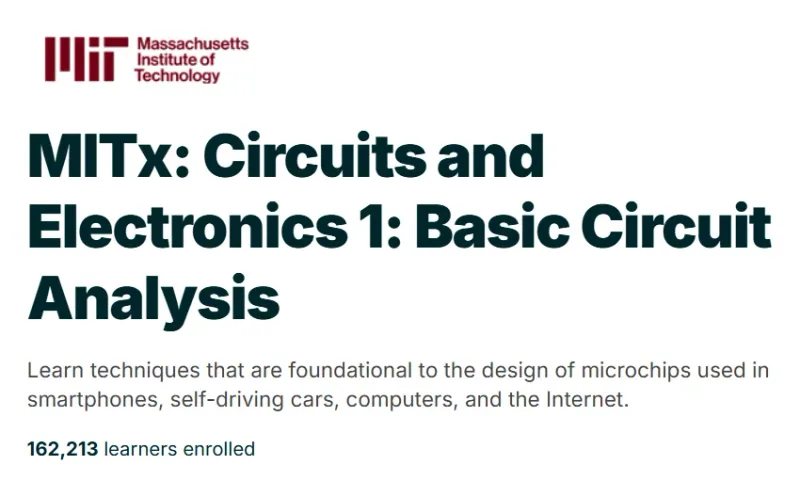
What will you learn in MITx: Circuits and Electronics 1: Basic Circuit Analysis course
- This course provides a strong foundation in electrical engineering by introducing the core principles of circuit analysis used in modern electronic systems.
- Learners will understand how voltage, current, resistance, and power interact within electrical circuits using fundamental laws such as Ohm’s Law and Kirchhoff’s Laws.
- The course emphasizes analytical problem-solving skills, enabling students to design and evaluate both DC and AC circuits confidently.
- Students will explore essential topics such as resistive networks, node and mesh analysis, operational amplifiers, and energy storage elements like capacitors and inductors.
- Real-world engineering applications and structured problem sets help learners connect theoretical concepts with practical electronics design.
- This course mirrors the rigor of MIT’s on-campus electrical engineering curriculum, making it ideal for serious learners and engineering aspirants.
Program Overview
Foundations of Circuit Analysis
⏳ 3–4 Weeks
- In this section, you will build a solid understanding of fundamental electrical quantities and laws governing circuits.
- Learn key principles such as Ohm’s Law, Kirchhoff’s Voltage Law (KVL), and Kirchhoff’s Current Law (KCL).
- Understand voltage-current relationships and how to analyze simple resistive networks.
- Develop systematic problem-solving techniques for basic circuit configurations.
Network Theorems and Advanced Analysis
⏳ 4–6 Weeks
- This part focuses on deeper circuit analysis techniques used in engineering design.
- Learn node-voltage and mesh-current methods for solving complex circuits.
- Understand Thevenin’s and Norton’s Theorems for circuit simplification.
- Analyze power transfer and energy distribution within electrical networks.
Capacitors, Inductors, and Dynamic Circuits
⏳ 4–6 Weeks
- In this section, you will explore time-dependent behavior in electrical systems.
- Study transient analysis in RC and RL circuits.
- Understand energy storage and time constants in dynamic systems.
- Analyze first-order and basic second-order circuits.
Operational Amplifiers and Applications
⏳ 3–4 Weeks
- Here, you will learn about one of the most important building blocks in electronics — the operational amplifier (Op-Amp).
- Understand ideal Op-Amp models and circuit configurations.
- Design amplifiers, integrators, and differentiators.
- Apply circuit analysis techniques to real-world signal processing problems.
Get certificate
Job Outlook
-
Electrical and electronics engineers are projected to experience steady demand across industries including telecommunications, renewable energy, automotive electronics, robotics, and semiconductor manufacturing.
-
Circuit analysis is a foundational skill required for careers such as Electrical Engineer, Electronics Engineer, Hardware Design Engineer, and Embedded Systems Engineer.
-
Entry-level electronics engineers typically earn between $65K–$85K per year, with experienced professionals earning $95K–$130K+ depending on specialization and region.
-
Strong circuit fundamentals are essential for advanced fields like VLSI design, power electronics, IoT hardware development, and robotics engineering.
-
This course significantly strengthens academic preparation for higher studies in electrical engineering or related technical fields.