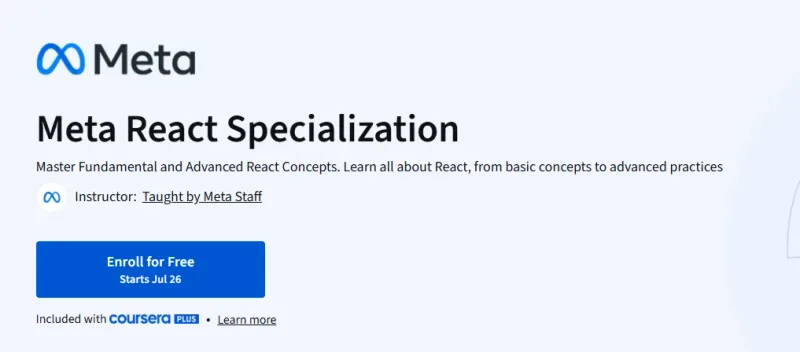
Meta React Specialization Course

Meta React Specialization Course Course

A comprehensive and beginner-friendly pathway to becoming a mobile app developer, directly from Meta, using React Native.

Explore This Course
9.8/10 Highly Recommended

Meta React Specialization Course on Coursera — A comprehensive and beginner-friendly pathway to becoming a mobile app developer, directly from Meta, using React Native.

Pros

  • Created by Meta (Facebook) engineers
  • Covers both core and advanced React Native concepts
  • Capstone project builds job-ready portfolio

Cons

  • Some concepts may move fast for true beginners
  • React Native apps may have limitations compared to fully native apps

Meta React Specialization Course Course

What will you learn in Meta React Specialization Course

  • Build mobile apps using React Native and Expo.

  • Implement navigation, data storage, and user interface design for iOS and Android.

​​​​​​​​​​

  • Work with APIs, authentication, and mobile app deployment.

  • Gain job-ready skills for junior mobile app developer roles.

Program Overview

Course 1: Introduction to Mobile Development

⏱️ 3 weeks

  • Topics: Mobile platforms, React Native basics, app development lifecycle.

  • Hands-on: Build a simple cross-platform app using Expo.

Course 2: Programming with JavaScript

⏱️ 4 weeks

  • Topics: JavaScript ES6+, functions, objects, arrays, DOM manipulation.

  • Hands-on: Write interactive scripts and basic web logic.

Course 3: React Basics

⏱️ 4 weeks

  • Topics: Components, props, state, hooks, JSX.

  • Hands-on: Develop interactive user interfaces in React.

Course 4: React Native

⏱️ 4 weeks

  • Topics: Platform differences, UI components, gestures, APIs.

  • Hands-on: Build native mobile interfaces.

Course 5: React Native Advanced

⏱️ 4 weeks

  • Topics: Navigation, performance optimization, animations.

  • Hands-on: Add advanced features and multi-screen navigation.

Course 6: Version Control

⏱️ 2 weeks

  • Topics: Git, GitHub, versioning, branching strategies.

  • Hands-on: Push projects to GitHub and manage source code.

Course 7: Capstone Project

⏱️ 4 weeks

  • Topics: Planning, building, and showcasing a real-world mobile app.

  • Hands-on: Create a portfolio-ready mobile application.

Get certificate

Job Outlook

  • High demand for React Native developers in startups and tech firms.

  • Junior mobile developers can expect salaries from $60,000 to $100,000 annually.

  • Growing remote and freelance opportunities.

  • React Native reduces time-to-market by enabling cross-platform development with one codebase.

Explore More Learning Paths

Take your engineering and management expertise to the next level with these hand-picked programs designed to expand your skills and boost your leadership potential.

Related Courses

  • Advanced React Course – Deepen your React expertise by mastering complex component patterns, performance optimization, and scalable front-end architecture.

  • Meta React Native Specialization Course – Learn to build high-performance mobile apps using React Native, covering UI components, navigation, APIs, and deployment.

  • React Basics Course – Start your React journey by understanding components, props, state, and the fundamentals of building interactive user interfaces.

Related Reading

Gain deeper insight into how project management drives real-world success:

FAQs

How much time should I dedicate weekly to complete the course effectively?
Estimated completion is around 4–6 months at a part-time pace. Weekly effort of 5–7 hours is generally sufficient for lectures and hands-on exercises. Regular practice in building components and projects reinforces learning. Revisiting assignments or experimenting with additional features may require extra time. Consistent engagement ensures learners develop both conceptual understanding and practical React skills.
How relevant are the skills taught for frontend development careers?
React is widely used in industry for building dynamic user interfaces. Skills gained improve employability for frontend and full-stack development roles. Projects demonstrate practical ability to potential employers. Knowledge of React complements existing JavaScript, HTML, and CSS skills. Completion shows readiness to contribute to real-world web development projects.
Can this course help me understand modern React features like hooks and context?
Hooks such as useState and useEffect are introduced and applied in projects. Context API is taught for managing global state in React applications. Practical exercises show when and how to use these features effectively. Knowledge of hooks and context prepares learners for modern frontend development. Skills gained are directly applicable to professional React projects.
Will I gain practical experience building React applications?
The course includes projects where learners build fully functional React apps. Learners practice using JSX, components, props, state, and events. Realistic examples simulate real-world web development workflows. Step-by-step guidance ensures understanding of best practices in React development. Hands-on projects help learners build a portfolio to showcase skills.
Do I need prior web development experience to take this course?
Basic knowledge of HTML, CSS, and JavaScript is recommended but not mandatory. The course introduces React concepts step-by-step for learners with minimal experience. Hands-on exercises guide learners through building functional React components. Beginners can gradually build confidence in creating interactive web applications. Supplemental tutorials may accelerate understanding of frontend development fundamentals.

Similar Courses

Other courses in Computer Science Courses