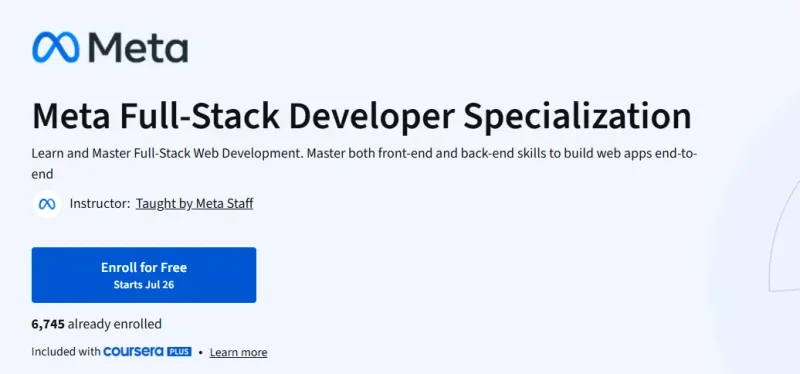
What will you learn in Meta Full-Stack Developer Specialization Course
-
Build front-end applications using HTML, CSS, JavaScript, and React.
-
Develop back-end applications using Node.js, Express, and APIs.
-
Work with databases like MongoDB for dynamic data handling.
-
Master Git, GitHub, version control, and deployment tools.
-
Create responsive, full-stack web applications from start to finish.
Program Overview
Course 1: Introduction to Front-End Development
⏱️ 3 weeks
-
Topics: Overview of front-end tools, workflows, and project structure
-
Hands-on: Build a basic HTML/CSS webpage.
Course 2: Programming with JavaScript
⏱️ 4 weeks
-
Topics: Variables, loops, functions, objects, and arrays
-
Hands-on: Create interactive web elements with vanilla JS.
Course 3: Version Control
⏱️ 2 weeks
-
Topics: Git basics, GitHub, pull/push, branches
-
Hands-on: Manage code with Git and collaborate using GitHub.
Course 4: HTML and CSS in Depth
⏱️ 4 weeks
-
Topics: Advanced layout, Flexbox, Grid, forms, responsive design
-
Hands-on: Develop a multi-page responsive website.
Course 5: React Basics
⏱️ 3 weeks
-
Topics: Components, props, hooks, state
-
Hands-on: Build a React SPA (Single Page Application).
Course 6: Advanced React
⏱️ 4 weeks
-
Topics: Context API, routing, performance optimization
-
Hands-on: Develop scalable React projects.
Course 7: Back-End Development
⏱️ 4 weeks
-
Topics: Node.js, Express.js, REST APIs
-
Hands-on: Set up a functional server and APIs.
Course 8: Databases
⏱️ 3 weeks
-
Topics: SQL vs. NoSQL, MongoDB basics, data modeling
-
Hands-on: Store and retrieve data using MongoDB.
Course 9: Full Stack Development
⏱️ 3 weeks
-
Topics: Client-server integration, end-to-end architecture
-
Hands-on: Connect React front-end to a Node/Express back-end.
Course 10: Final Capstone Project
⏱️ 3–4 weeks
-
Topics: Full-stack application design, development, and deployment
-
Hands-on: Build and deploy a full-stack project with frontend, backend, and database integration.
Get certificate
Job Outlook
- Full stack developers are in consistently high demand across tech industries.
- Average salary: $75K–$130K/year globally depending on location and experience.
- Roles include web developer, software engineer, and tech consultant.
- High potential for freelance and startup opportunities.
Explore More Learning Paths
Take your engineering and management expertise to the next level with these hand-picked programs designed to expand your skills and boost your leadership potential.
Related Courses
-
IBM Full-Stack JavaScript Developer Professional Certificate Course – Learn full-stack development with JavaScript, covering both front-end and back-end technologies to build robust applications.
-
Microsoft Full-Stack Developer Professional Certificate Course – Gain hands-on experience with modern web frameworks, databases, and deployment practices for enterprise-grade full-stack projects.
-
Building Full-Stack Web Applications with Node.js and React Course – Master full-stack web development by creating dynamic applications using Node.js for the server and React for the client interface.
Related Reading
Gain deeper insight into how project management drives real-world success:
-
What Is Project Management? – Understand the principles that make every great project a success story.