What will you learn in Introduction to Java Course
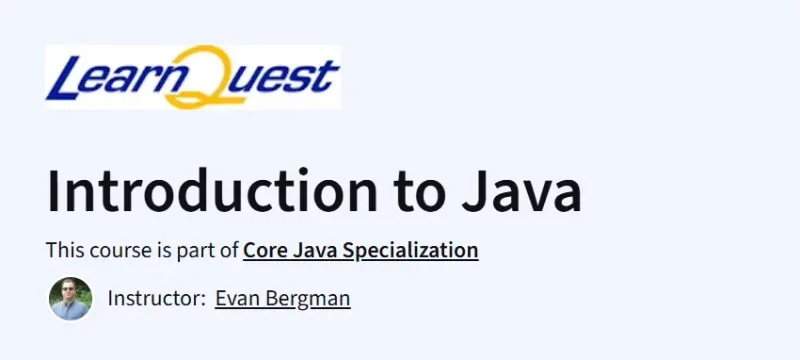
- This course provides a beginner-friendly introduction to Java programming and core computer science principles.
- Learners will understand object-oriented programming (OOP) concepts such as classes, objects, methods, and inheritance.
- The course emphasizes writing clean, structured Java code and solving computational problems.
- Students will explore control flow, loops, conditionals, arrays, and basic data structures.
- Hands-on programming assignments reinforce real-world application of Java concepts.
- By the end of the course, participants will gain strong foundational skills required for further study in software development and computer science.
Program Overview
Java Programming Fundamentals
⏳ 2–3 Weeks
- Understand Java syntax and development environment setup.
- Learn variables, data types, operators, and expressions.
- Write simple programs using conditionals and loops.
- Develop problem-solving confidence.
Object-Oriented Programming Concepts
⏳ 2–3 Weeks
- Learn about classes and objects.
- Understand constructors and methods.
- Explore encapsulation and modular design.
- Apply OOP principles in structured programs.
Arrays and Data Processing
⏳ 2–3 Weeks
- Work with arrays and collections of data.
- Process data using loops and methods.
- Develop small projects using real datasets.
- Strengthen debugging and testing skills.
Practical Programming Projects
⏳ Final Weeks
- Build small Java applications.
- Apply structured programming techniques.
- Analyze program performance and correctness.
- Demonstrate mastery through graded assignments.
Get certificate
Job Outlook
- Java remains one of the most widely used programming languages in enterprise software, Android development, financial systems, and backend web services.
- Professionals skilled in Java are sought for roles such as Java Developer, Backend Developer, Software Engineer, and Android Developer.
- Entry-level Java developers typically earn between $75K–$100K per year, while experienced software engineers can earn $110K–$160K+ depending on specialization and region.
- Java is widely used in large-scale enterprise systems, making it a stable and long-term career skill.
- This course provides a strong starting point for advanced Java frameworks such as Spring Boot and enterprise application development.