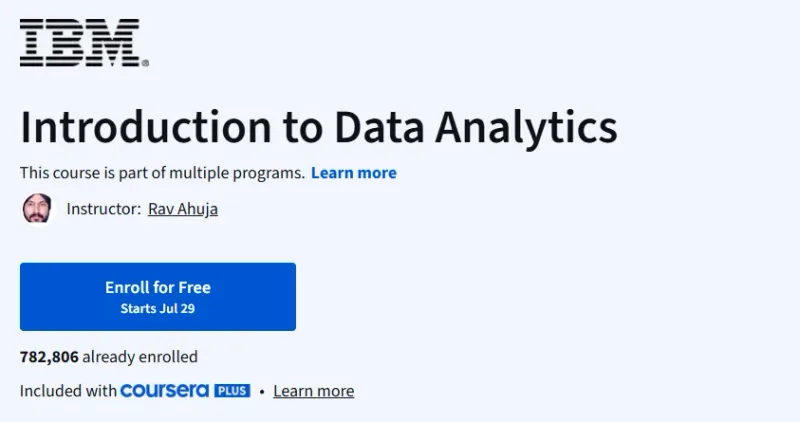
Introduction to Data Analytics Course

Introduction to Data Analytics Course Course

A beginner-friendly and structured course that lays the foundation for anyone new to data analytics. It simplifies core concepts and sets learners up for more advanced studies.

Explore This Course
9.8/10 Highly Recommended

Introduction to Data Analytics Course on Coursera — A beginner-friendly and structured course that lays the foundation for anyone new to data analytics. It simplifies core concepts and sets learners up for more advanced studies.

Pros

  • Taught by IBM professionals
  • Easy to follow and short
  • Real-world context for all topics

Cons

  • Lacks deep technical projects
  • Basic coverage of tools (no heavy hands-on)

Introduction to Data Analytics Course Course

Platform: Coursera

What will you learn in Introduction to Data Analytics Course

  • Understand the data analysis lifecycle and its real-world applications.

  • Identify different types of data structures and data roles.

​​​​​​​​​​

  • Learn foundational concepts of data visualization and statistical techniques.

  • Explore common tools used in data analytics including Excel, R, and Python.

Program Overview

Module 1: Introduction to Data Analytics

⏱️ 1 week

  • Topics: Role of data analysts, data ecosystem, data-driven decision-making

  • Hands-on: Real-world case discussions on data use in business

Module 2: Analytical Skills and Tools

⏱️ 1 week

  • Topics: Basic concepts of spreadsheets, SQL, R, and Python

  • Hands-on: Tool comparison exercises and guided tool introductions

Module 3: Data Ecosystem and Key Concepts

⏱️ 1 week

  • Topics: Databases, data warehouses, and data lakes

  • Hands-on: Simple walkthroughs of data environments

Module 4: Data Visualization and Insights

⏱️ 1 week

  • Topics: Charts, dashboards, storytelling with data

  • Hands-on: Creating visual insights from sample datasets

Get certificate

Job Outlook

  • Strong job market for data analysts across industries.

  • Average salary ranges between $60K–$90K for entry-level roles.

  • Solid stepping stone for careers in data science, business intelligence, and analytics.

  • Opportunities in freelancing, consulting, and corporate analytics teams.

Explore More Learning Paths

Strengthen your data literacy and analytical thinking with these carefully selected programs designed to build your expertise and prepare you for real-world data challenges.

Related Courses

Related Reading

Gain deeper insight into how project management drives real-world success:

FAQs

How much time should I dedicate weekly to complete the course effectively?
Estimated completion is around 4–6 weeks at a part-time pace. Weekly effort of 3–5 hours is generally sufficient to follow lessons and complete exercises. Consistent practice in data manipulation and visualization improves retention. Revisiting exercises or exploring additional datasets may require extra time. Regular engagement ensures learners develop both conceptual understanding and practical skills.
How relevant are the tools taught in the course to industry standards?
The course covers widely used tools like Excel and introductory analytics software. Skills in data cleaning, visualization, and reporting are transferable to many platforms. Concepts learned provide a strong foundation for learning SQL, Python, or R later. Exposure to these tools helps beginners understand analytics workflows. Practical exercises simulate real-world analytics tasks.
Can this course help me pursue a career in data analytics?
It provides foundational knowledge necessary for data analyst roles. Learners gain skills in Excel, data visualization, and data interpretation. Understanding of basic analytics concepts supports further learning in specialized areas. Completion can strengthen applications for internships or junior analytics positions. Additional practice or advanced courses may be needed for more technical roles.
Will I gain hands-on experience with real datasets?
The course includes exercises using real-world datasets for analysis. Learners practice data cleaning, visualization, and basic statistical analysis. Step-by-step guidance ensures beginners can handle datasets confidently. Exercises simulate real workplace scenarios in data analytics. Hands-on practice helps build skills for portfolio projects or internships.
Do I need prior knowledge of statistics or programming to start this course?
The course is designed for beginners and assumes no prior programming knowledge. Basic familiarity with Excel or spreadsheets can help, but isn’t mandatory. Introductory statistics concepts are explained as part of the course. Learners can follow along with guided exercises and examples. Additional resources may be used for practice in statistics or data handling.

Similar Courses

Other courses in Computer Science Courses