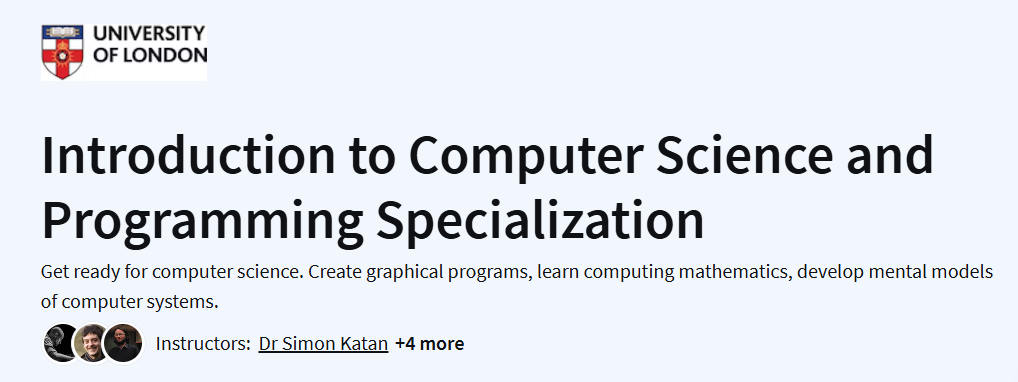
Introduction to Computer Science and Programming Specialization Course

Introduction to Computer Science and Programming Specialization Course Course

The Introduction to Computer Science and Programming Specialization offers a comprehensive introduction to essential computing concepts. It's particularly well-suited for beginners seeking to build a ...

Explore This Course Quick Enroll Page
9.6/10 Highly Recommended

Introduction to Computer Science and Programming Specialization Course on Coursera — The Introduction to Computer Science and Programming Specialization offers a comprehensive introduction to essential computing concepts. It's particularly well-suited for beginners seeking to build a solid foundation in programming and computer science principles.

Pros

  • Comprehensive coverage of foundational topics in computer science.​
  • Interactive projects that reinforce learning through practical application.​
  • Flexible online format suitable for self-paced learning.​
  • Instruction from experienced University of London faculty.​

Cons

  • Requires a commitment of approximately 10 hours per week over two months.​
  • Some prior familiarity with basic mathematics is beneficial.

Introduction to Computer Science and Programming Specialization Course Course

Platform: Coursera

Instructor: University of London

What you will learn in Introduction to Computer Science and Programming Specialization Course

  • Gain foundational programming skills using JavaScript and the p5.js library to create interactive 2D graphics.
  • Understand core computing principles, including number base conversions, modular arithmetic, sequences, series, and graph plotting.

  • Develop mental models to describe the workings of various computer systems, enhancing problem-solving and critical thinking abilities.

Program Overview

Introduction to Computer Programming

⏱️  21 hours

  • Learn the basics of editing and running programs.
  • Create 2D graphics using shapes and coordinates.
  • Develop interactive graphics controlled by mouse input.
  • Apply coding skills to solve interactive puzzles in the Sleuth game.​​

How Computers Work

⏱️ 10 hours

  • Explore fundamental concepts of computer systems.
  • Apply these concepts to everyday computer applications like word processing and web browsing.
  • Enhance understanding of software and hardware interactions.

Linear Transformations

⏱️38 hours

  • Transform numbers between different bases and perform arithmetic operations.
  • Identify and compute sequences and their sums.
  • Represent space numerically using coordinates and graphs.
  • Study functions and their graphs to describe variations in quantities

Get certificate

Job Outlook

  • This specialization provides a strong foundation for careers in computer science, software development, and data analysis.
  • Skills acquired are applicable to roles requiring problem-solving, programming, and analytical thinking.
  • Completing this program can serve as a stepping stone to more advanced studies or entry-level positions in the tech industry.

Explore More Learning Paths

Build a strong foundation in computer science and programming with these curated courses designed to strengthen your problem-solving, mathematical reasoning, and coding skills.

Related Courses

Related Reading

Enhance your understanding of structured data and system organization:

  • What Is Data Management? – Learn how organizing and managing data efficiently underpins programming, algorithm design, and software development.
FAQs

What are the strengths and limitations of this specialization?
Strengths: Well-structured beginner curriculum spanning programming, systems, and math. Developed by the University of London, offering academic credibility and a shareable certificate. Includes creative assignments that support both conceptual understanding and practical coding. Limitations: This is a "taster" series and does not supply full academic credits toward a BSc program. It's not aligned with the full longer modules of the university degree. Heavy theory (especially in "How Computers Work") may require supplemental materials or patience.
What are common learner experiences in terms of workload?
Some Reddit learners report that weekly time requirements can vary—some modules feel lighter, others more time-intensive. One learner noted completing 2 weeks of math content in 2–3 hours per week. Others share that you might need 10–15 hours/week, especially for math-intensive modules or if you're new to coding.
What practical projects and topics are included?
The specialization comprises three courses: Introduction to Computer Programming (~21 hours): Learn JavaScript and p5.js to build interactive graphical programs. How Computers Work (~210 hours total): Explore computer systems, architecture, networking fundamentals, and computational models. Mathematics for Computer Science (~39–40 hours): Cover bases, sequences, graphs, and computational math tools. Learners engage in hands-on, creative tasks, such as solving puzzles, building graphical applications, and working with computational models.
Is any prior programming or technical experience required?
This is a beginner-level program—no prior coding or computer science experience is required. It’s ideal for learners entirely new to computer science, offering foundational introductions to programming, system architecture, and computational thinking.
How long does it take to complete, and how flexible is the schedule?
The specialization includes 3 courses and Coursera recommends 4 weeks per course at 10 hours/week, totaling around 12 weeks. Estimated effort is roughly 3–4 months, aligning with a 10-hour-per-week pace. Your actual time will depend on familiarity with the material—some learners complete modules faster if they already know Python or are strong in math. The format is self-paced, offering flexibility to progress on your own schedule.

Similar Courses

Other courses in Computer Science Courses