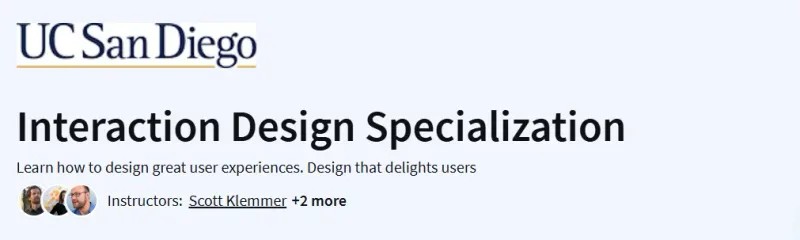
What will you learn in this Interaction Design Specialization Course
-
Human-Centered Design: Understand the principles of designing technologies that bring joy rather than frustration.
-
Rapid Prototyping Techniques: Learn methods like paper prototyping and Wizard of Oz prototyping to quickly visualize and test design ideas.
-
User Research & Evaluation: Conduct fieldwork to gather user insights and evaluate interface alternatives effectively.
-
Visual Design Principles: Gain knowledge in typography, layout, color theory, and information architecture to create intuitive interfaces.
-
Social Computing: Explore the challenges and opportunities in creating online communities and collaborative experiences.
-
Interaction Techniques: Study human motor performance, perception, and cognition to inform effective interaction design.
-
Experimentation & Analysis: Design, run, and analyze user-centered experiments to validate design decisions.
-
Capstone Project: Apply all learned skills to a comprehensive project, redesigning an interface, service, or product.
Program Overview
1. Human-Centered Design: an Introduction
⏳ 14 hours
-
Learn to design technologies that bring joy.
-
Techniques for rapid prototyping and evaluating interfaces.
-
Conducting fieldwork to gather design ideas.
2. Design Principles: an Introduction
⏳ 12 hours
-
Fundamental principles of visual design.
-
Organizing and presenting information effectively.
-
Evaluating designs through user feedback.
3. Social Computing
⏳ 9 hours
-
Understanding online communities and collaboration.
-
Challenges and opportunities in social computing.
4. Input and Interaction
⏳ 9 hours
-
Human motor performance, perception, and cognition.
-
Designing effective input and interaction techniques.
5. User Experience: Research & Prototyping
⏳ 11 hours
-
Core processes of experience design.
-
Methods for understanding user behavior and context.
-
Transforming observations into actionable insights.
6. Information Design
⏳ 13 hours
-
Principles of visual design for interfaces.
-
Strategies for creating user interfaces across devices.
-
Applying design principles in diverse contexts.
7. Designing, Running, and Analyzing Experiments
⏳ 15 hours
-
Designing user-centered experiments.
-
Running experiments and analyzing data using R.
-
Evaluating and validating user experiences.
8. Interaction Design Capstone Project
⏳ 35 hours
-
Apply skills from previous courses to a comprehensive project.
-
Redesign an interface, service, or product.
-
Develop a polished project to showcase in your portfolio.
Get certificate
Job Outlook
-
High demand for UX/UI designers, interaction designers, and user researchers.
-
Skills applicable in tech companies, startups, and design agencies.
-
Opportunities to work on web, mobile, and emerging technologies.
-
Foundation for roles in product design, usability analysis, and HCI research.