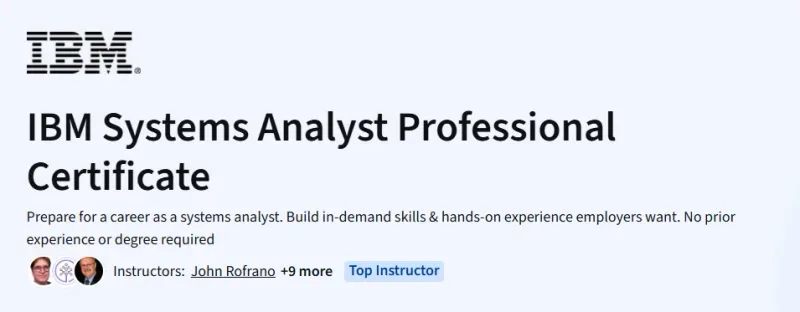
What will you learn in IBM Systems Analyst Professional Certificate Course
-
Understand the role and responsibilities of a systems analyst in IT environments.
-
Analyze business problems and recommend technological solutions.
-
Develop models, process flows, and use cases for system requirements.
-
Master tools for requirements gathering, modeling, and software analysis.
Program Overview
Module 1: Introduction to Systems Analysis
⏱️ 1 week
-
Topics: Role of systems analyst, software development life cycle (SDLC), requirement types
-
Hands-on: Analyze a system development scenario
Module 2: Business Process Modeling and Use Cases
⏱️ 2 weeks
-
Topics: UML diagrams, BPMN, user stories, and use case modeling
-
Hands-on: Create business process models and use cases for a sample project
Module 3: Requirements Gathering Techniques
⏱️ 2 weeks
-
Topics: Interviews, surveys, document analysis, workshops
- Hands-on: Conduct mock requirement-gathering sessions
Module 4: Data and Functional Modeling
⏱️ 2 weeks
-
Topics: ER diagrams, data flow diagrams (DFDs), logical vs physical models
-
Hands-on: Design data models for a business use case
Module 5: Agile and Waterfall Methodologies
⏱️ 1 week
-
Topics: Key principles, differences, best use cases
-
Hands-on: Align system analysis tasks with both Agile and Waterfall projects
Module 6: Tools for Systems Analysts
⏱️ 2 weeks
-
Topics: JIRA, Lucidchart, IBM Engineering Lifecycle Management
-
Hands-on: Use cloud-based tools for modeling and tracking requirements
Capstone Project: Systems Analysis for a Real-World Business
⏱️ 2 weeks
-
Topics: Complete analysis for a hypothetical client
-
Hands-on: Create documentation, models, and requirement specs
Get certificate
Job Outlook
-
Growing demand across industries for business and systems analysts.
-
Titles include Systems Analyst, Requirements Analyst, IT Business Analyst.
-
Average salary range: $80,000–$110,000 annually.
-
Remote and freelance roles available in tech and consulting sectors.
Explore More Learning Paths
Take your engineering and management expertise to the next level with these hand-picked programs designed to expand your skills and boost your leadership potential.
Related Courses
-
Information Systems Specialization Course – Build a strong foundation in information systems, covering system design, data flows, IT infrastructure, and enterprise-level technology management.
-
Introduction to Computers and Operating Systems and Security – Learn essential IT fundamentals, including hardware, operating systems, networking, and basic cybersecurity concepts needed for systems-related roles.
-
Computer Security and Systems Management Specialization Course – Develop practical skills in system administration, security configuration, risk mitigation, and managing enterprise-grade IT environments.
Related Reading
Gain deeper insight into how project management drives real-world success:
-
What Is Project Management? – Understand the principles that make every great project a success story.