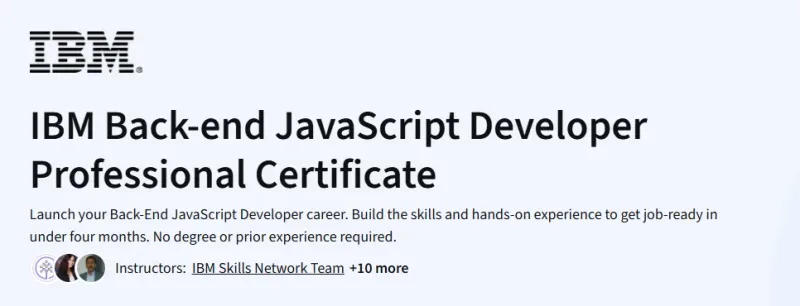
What will you learn in IBM Back-end JavaScript Developer Professional Certificate Course
-
Core JavaScript skills for back-end development.
-
How to use Node.js, Express, and REST APIs.
-
Working with NoSQL databases like MongoDB.
-
Debugging, testing, and securing JavaScript applications.
-
Building and deploying complete back-end applications.
Program Overview
Module 1: Introduction to Software Engineering
⏳ Duration: 1 week
-
Topics: Developer roles, software development lifecycle, tools overview
-
Hands-on: Basic developer environment setup
Module 2: JavaScript Basics
⏳ Duration: 2 weeks
-
Topics: Syntax, variables, functions, loops, arrays, objects
-
Hands-on: Simple programs to practice logic building
Module 3: Version Control with GitHub
⏳ Duration: 1 week
-
Topics: Git basics, branching, merging, pull requests
-
Hands-on: Push and manage code in GitHub
Module 4: Backend JavaScript with Node.js
⏳ Duration: 3 weeks
-
Topics: Node.js fundamentals, modules, package management
-
Hands-on: Build a CLI or local Node.js tool
Module 5: Express and REST APIs
⏳ Duration: 3 weeks
-
Topics: Express.js routing, middleware, creating APIs
-
Hands-on: Build a CRUD REST API
Module 6: MongoDB and NoSQL
⏳ Duration: 2 weeks
-
Topics: Schema design, CRUD operations with MongoDB
-
Hands-on: Connect backend to database
Module 7: Testing, Debugging & Security
⏳ Duration: 2 weeks
-
Topics: Unit testing, error handling, securing APIs
-
Hands-on: Write secure, testable APIs
Module 8: Final Capstone Project
⏳ Duration: 3 weeks
-
Topics: Full back-end app integrating all learned skills
-
Hands-on: Complete and deploy a working backend system
Get certificate
Job Outlook
-
High Demand: JavaScript and Node.js developers remain in strong demand globally.
-
Roles: Back-End Developer, Full Stack Developer, Node.js Engineer.
-
Salary Range: $70,000–$120,000/year globally, higher in U.S. and Europe.
-
Freelance Potential: High for API and backend systems.
Explore More Learning Paths
Take your engineering and management expertise to the next level with these hand-picked programs designed to expand your skills and boost your leadership potential.
Related Courses
-
Microsoft Back-End Developer Professional Certificate Course – Build job-ready back-end development expertise with Microsoft’s structured curriculum covering APIs, databases, C#, .NET, and scalable server-side systems.
-
Introduction to Back-End Development Course – Start your journey with a strong foundation in server-side architecture, databases, APIs, and essential backend concepts used across modern applications.
-
IBM Back-End Development Professional Certificate Course – Gain comprehensive training in backend programming, cloud deployment, data processing, and real-world back-end project development using IBM technologies.
Related Reading
Gain deeper insight into how project management drives real-world success:
-
What Is Project Management? – Understand the principles that make every great project a success story.