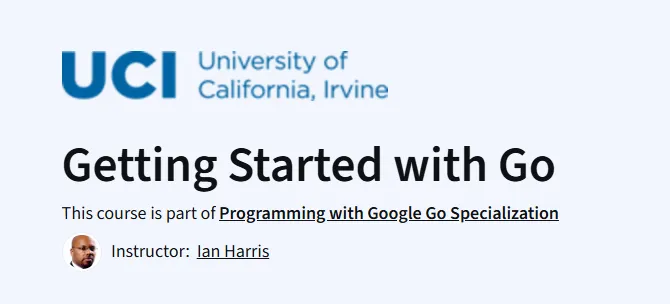
What will you learn in Getting Started with Go Course
-
Set up Go’s development environment and write your first “Hello, World!” program.
-
Explore Go’s advantages, basic syntax, variables, and workspaces.
-
Understand data types, including numbers, strings, arrays, slices, maps, and structs.
-
Handle protocols and formats: learn to work with RFCs and JSON in Go.
-
Practice writing simple Go programs with peer feedback.
Program Overview
Module 1: Getting Started with Go
Duration: ~2 hours total
-
Topics: Why learn Go? Advantages, Go’s objects and concurrency, installing Go, workspaces, packages, basic variables and initialization.
-
Hands-on: Set up your Go environment, write your first “Hello, world!” program, complete a quiz and peer-reviewed assignment.
Module 2: Basic Data Types
Duration: ~4 hours total
-
Topics: Data types in Go (ints, floats, strings, constants), control flow structures (loops, conditionals), comments, printing.
-
Hands-on: Use and manipulate data types; practice with control statements; complete readings, exercises, and a quiz.
Module 3: Composite Data Types
Duration: Not specified
-
Topics: Explore composite types such as arrays, slices, maps, and structs.
-
Hands-on: Create and manipulate composite data structures; complete module quiz.
Module 4: Protocols and Formats
Duration: Not specified
-
Topics: Work with RFCs, JSON, and file access using
ioutilandospackages. -
Hands-on: Read/write JSON, handle files, and complete the module’s quiz.
Get certificate
Job Outlook
-
Prepares you for roles like Backend Developer, Go Programmer, DevOps Engineer, or Cloud Engineer.
-
Go is valued in industries needing efficient, scalable backend solutions—especially cloud services and concurrent systems.
-
Developers with Go expertise often command strong salaries, ranging from ₹10–20 LPA in India to $70,000–$120,000 USD globally.
Explore More Learning Paths
Build a strong foundation in Go programming with these carefully curated courses designed to help you progress from beginner concepts to advanced programming techniques.
Related Courses
-
Programming with Google Go Specialization Course – Master Go programming through in-depth lessons and hands-on projects for real-world applications.
-
Functions, Methods, and Interfaces in Go Course – Dive deeper into Go’s key concepts, including functions, methods, and interfaces for building efficient programs.
-
An Introduction to Programming in Go Course – Learn Go fundamentals such as syntax, variables, loops, and data structures to start coding confidently.
Related Reading
-
What Is Programming Used For? – Discover how programming languages like Go are applied in software development, cloud computing, and data-driven applications.