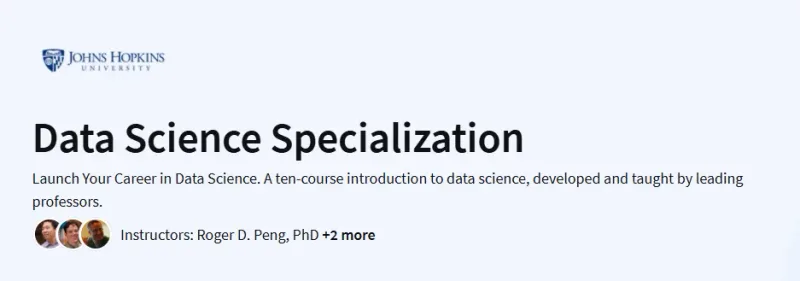
What you will learn in Data Science Specialization Course
-
Gain proficiency in R programming for data analysis and visualization.
-
Understand the entire data science process, from data acquisition to modeling and interpretation.
-
Develop skills in statistical inference and machine learning techniques.
-
Learn to manage and manipulate data using databases and tools like GitHub.
-
Create reproducible research reports and presentations.
Program Overview
The Data Scientist’s Toolbox
⏱️ 4 weeks
-
Introduction to data science and the roles of data scientists.
-
Overview of tools such as version control, markdown, Git, GitHub, R, and RStudio.
R Programming
⏱️ 4 weeks
- Fundamentals of R syntax and programming concepts.
- Data types, control structures, functions, and debugging in R.
Getting and Cleaning Data
⏱️4 weeks
- Techniques for obtaining data from various sources.
- Data cleaning and preprocessing methods to ensure data quality.
Exploratory Data Analysis
⏱️ 4 weeks
- Visualization techniques to summarize and understand data.
- Application of statistical methods to explore data patterns.
Reproducible Research
⏱️ 4 weeks
-
Principles and practices for creating reproducible research.
-
Use of R Markdown and knitr for documentation.
Statistical Inference
⏱️ 4 weeks
-
Concepts of statistical inference and hypothesis testing.
-
Application of resampling methods and confidence intervals.
Regression Models
⏱️ 4 weeks
-
Linear regression techniques and model building.
-
Interpretation of regression coefficients and diagnostics.
Practical Machine Learning
⏱️ 4 weeks
- Introduction to machine learning algorithms and their applications.
- Model training, validation, and performance evaluation.
Developing Data Products
⏱️ 4 weeks
- Creation of interactive data products using Shiny, R packages, and APIs.
- Deployment of data products for end-user interaction.
Data Science Capstone
⏱️ 6 weeks
-
Application of acquired skills to a real-world project.
-
Development and presentation of a data product addressing a specific problem.
Get certificate
Job Outlook
- Growing demand for data science professionals across various industries.
- Skills acquired are applicable to roles such as Data Analyst, Data Scientist, and Business Analyst.
- Proficiency in R and data analysis techniques enhances employability.
- Experience with real-world projects through the capstone increases job readiness.
Explore More Learning Paths
Advance your data science skills with these carefully selected courses designed to provide foundational knowledge, hands-on experience, and technical expertise in analyzing complex data.
Related Courses
-
What Is Data Science Course – Understand the fundamentals of data science, its applications, and the core skills needed to succeed in the field.
-
Foundations of Data Science Course – Build a solid foundation in data analysis, statistical methods, and data visualization for real-world problem solving.
-
Tools for Data Science Course – Gain proficiency in essential data science tools and programming languages for efficient data analysis and insights.
Related Reading
Gain deeper insight into how structured data management underpins data-driven decision-making:
-
What Is Data Management? – Learn how proper data management ensures accuracy, reliability, and actionable insights in data science projects.