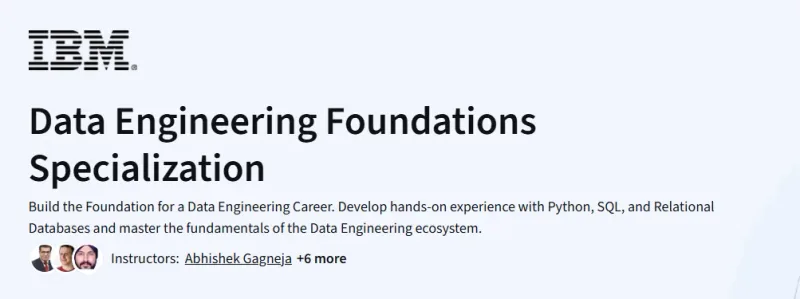
What will you learn in Data Engineering Foundations Specialization Course
-
Core principles of data engineering and its role in data-driven organizations.
-
How to work with relational and non-relational databases.
-
Skills to manage big data and use ETL tools.
-
Basics of cloud platforms and distributed computing.
-
Data pipelines, warehouses, lakes, and business intelligence systems.
Program Overview
1. Introduction to Data Engineering
⏱️ 1 week
-
Topics: Data engineer roles, data lifecycle, architecture basics.
-
Hands-on: Case studies and cloud-based tools overview.
2. Introduction to Relational Databases (RDBMS)
⏱️ 2 weeks
-
Topics: SQL basics, ER diagrams, normalization, indexes.
-
Hands-on: Writing SQL queries, building and querying tables.
3. Introduction to NoSQL Databases
⏱️ 2 weeks
-
Topics: Document, key-value, column, and graph databases.
-
Hands-on: Working with MongoDB and JSON-based data structures.
4. ETL and Data Pipelines with Shell, Airflow, and Kafka
⏱️ 3 weeks
-
Topics: Data ingestion, transformation, scheduling, stream processing.
-
Hands-on: Create pipelines using Apache Airflow and Kafka simulations.
Get certificate
Job Outlook
-
High Demand: Data engineering roles are rapidly growing with cloud and big data adoption.
-
Career Opportunities: Data Engineer, ETL Developer, Data Architect.
-
Salary Potential: $80,000–$150,000/year depending on location and experience.
-
Freelance Scope: Strong potential for freelance/contract-based data integration and pipeline projects.
Explore More Learning Paths
Take your engineering and management expertise to the next level with these hand-picked programs designed to expand your skills and boost your leadership potential.
Related Courses
-
Data Engineering, Big Data, and Machine Learning on GCP Course – Develop advanced data engineering skills using Google Cloud tools for big data processing, ML pipelines, and end-to-end data workflows.
-
IBM Data Engineering Professional Certificate Course – Gain hands-on experience in databases, ETL pipelines, data warehouses, and analytics platforms to prepare for real-world data engineering roles.
-
Introduction to Data Engineering by IBM – Learn the fundamentals of data architecture, ingestion, storage, and data pipeline development to build a strong foundation in the field.
Related Reading
Gain deeper insight into how project management drives real-world success:
-
What Is Project Management? – Understand the principles that make every great project a success story.