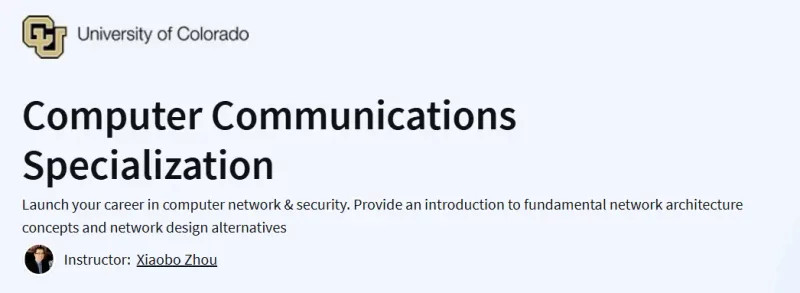
Computer Communications Specialization Course

Computer Communications Specialization Course Course

An in-depth specialization that offers practical insights into computer communications, suitable for professionals aiming to deepen their networking expertise.

Explore This Course
9.7/10 Highly Recommended

Computer Communications Specialization Course on Coursera — An in-depth specialization that offers practical insights into computer communications, suitable for professionals aiming to deepen their networking expertise.

Pros

  • Taught by experienced instructors from the University of Colorado System.
  • Hands-on projects reinforce learning.
  • Flexible schedule suitable for working professionals.
  • Provides a shareable certificate upon completion.

Cons

  • Requires a foundational understanding of programming (preferably in C) and basic probability.
  • Some advanced topics may be challenging without prior experience.

Computer Communications Specialization Course Course

Platform: Coursera

What will you learn in this Computer Communications Specialization Course

  • Understand fundamental concepts of computer networking, including layered architectures and protocol design.

  • Analyze and implement peer-to-peer protocols and local area networks (LANs).

​​​​​​​​​​

  • Explore packet switching networks, routing algorithms, and congestion control mechanisms.

  • Gain in-depth knowledge of TCP/IP protocols and advanced networking topics such as multicast, software-defined networking (SDN), and network security.

Program Overview

1. Fundamentals of Network Communication
⏳  15 hours
Learn the evolution of networks, key concepts of layered architectures, and fundamental digital communication principles, including error control techniques.

2. Peer-to-Peer Protocols and Local Area Networks
⏳  15 hours
Study peer-to-peer protocols, medium access control protocols, and the design and performance of local area networks, including wireless LANs. 

3. Packet Switching Networks and Algorithms
⏳  17 hours
Delve into packet switching networks, exploring internal operations, routing procedures, addressing, and congestion control strategies. 

4. TCP/IP and Advanced Topics
⏳  16 hours
Examine the TCP/IP protocol suite in detail, including IP addressing, TCP mechanisms, and advanced topics like multicast, SDN, and network security considerations.


Get certificate

Job Outlook

  • Equips learners for roles such as Network Engineer, Systems Administrator, and IT Infrastructure Specialist.

  • Applicable in industries like telecommunications, cloud services, cybersecurity, and enterprise IT.

  • Enhances employability by providing practical skills in network design, implementation, and analysis.

  • Supports career advancement in network architecture and security domains.

Explore More Learning Paths

Enhance your understanding of computer communications and networking with these carefully selected courses designed to strengthen your technical foundation and practical skills.

Related Courses

Related Reading

FAQs

How challenging is this specialization for someone with only basic programming knowledge?
Medium-level difficulty; basic programming knowledge required. Advanced topics like SDN and multicast may need extra effort. Regular practice of coding and networking exercises helps understanding. Gradual learning approach supports skill development. Recommended to review programming fundamentals before starting.
How practical are the hands-on projects in this course?
Projects simulate real-world network configurations and protocol design. Encourages implementation of peer-to-peer networks and LANs. Helps practice routing, congestion control, and TCP/IP mechanisms. Projects reinforce theory with applied problem-solving. Suitable for building a portfolio of networking skills.
Will this specialization prepare me for network certifications like CCNA?
Covers TCP/IP, LANs, routing, and network protocols foundational to certifications. Not a direct exam prep course, but builds essential knowledge. Useful as a stepping stone before specialized certification training. Practical exercises reinforce conceptual understanding. Supports preparation for both vendor-specific and general networking exams.
Can I apply these skills outside traditional IT jobs?
Skills apply in cloud services and telecommunications. Useful for cybersecurity and IT infrastructure roles. Enhances understanding for software engineers working on networked applications. Applicable in enterprise IT and large organizations. Knowledge supports innovation in emerging tech like SDN and IoT.
Do I need prior experience in networking to enroll in this specialization?
Basic programming knowledge, preferably in C, is recommended. Foundational understanding of probability helps but isn’t mandatory. No prior networking experience is required. Beginners with programming background can follow along. The course gradually introduces networking concepts from fundamentals.

Similar Courses

Other courses in Computer Science Courses