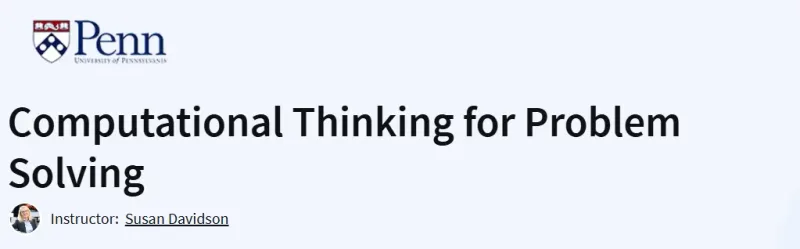
What you will learn in Computational Thinking for Problem Solving
-
Grasp the four pillars of computational thinking: decomposition, pattern recognition, data representation and abstraction, and algorithms.
-
Develop and analyze algorithms, understanding their efficiency and application.
-
Comprehend the fundamental operations of modern computers, including the von Neumann architecture.
-
Translate problem-solving strategies into Python code, even without prior programming experience.
Program Overview
Module 1: Pillars of Computational Thinking
⏳ 3 hours
- Introduction to the core concepts of computational thinking and their application in problem-solving.
Module 2: Expressing and Analyzing Algorithms
⏳ 4 hours
- Learn to develop algorithms and assess their performance, including understanding algorithmic complexity.
Module 3: Fundamental Operations of a Modern Computer
⏳ 3 hours
- Explore how computers execute instructions and manage data, including an overview of the von Neumann architecture.
Module 4: Applied Computational Thinking Using Python
⏳ 6 hours
- Apply computational thinking by writing simple Python programs to solve problems.
Get certificate
Job Outlook
-
Completing this course enhances problem-solving and analytical skills applicable across various industries.
-
Provides a foundation for further studies in computer science and programming.
-
Equips learners with skills relevant to roles requiring analytical and computational thinking.
Explore More Learning Paths
Sharpen your problem-solving and analytical skills with these carefully curated programs designed to help you apply computational thinking, structured reasoning, and creative solutions in real-world scenarios.
Related Courses
-
Excel VBA for Creative Problem Solving Specialization Course – Learn to leverage Excel and VBA tools to automate tasks and solve complex problems efficiently.
-
Effective Problem Solving and Decision Making Course – Develop structured approaches to identify, analyze, and solve challenges in personal and professional settings.
-
People and Soft Skills for Professional and Personal Success Specialization Course – Enhance communication, teamwork, and interpersonal skills to support effective problem-solving and collaboration.
Related Reading
-
What Is Knowledge Management? – Understand how managing, organizing, and leveraging knowledge improves decision-making and problem-solving processes, complementing computational thinking approaches.