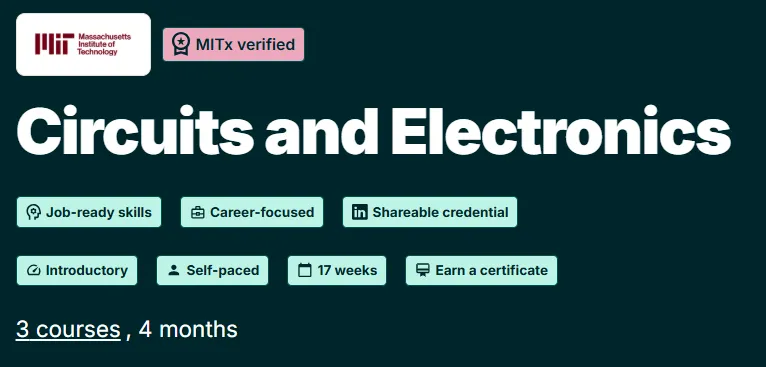
What will you learn in Circuits and Electronics course
- This XSeries program provides a comprehensive, university-level foundation in electrical engineering through MIT’s renowned Circuits and Electronics curriculum.
- Learners will master the principles of circuit analysis, including voltage, current, resistance, and power relationships.
- The program emphasizes transistor operation, amplification, and high-speed circuit behavior in modern electronic systems.
- Students will explore frequency response, signal delay, and integrated circuit applications.
- Advanced modules develop system-level thinking for analog and digital electronics design.
- By completing the series, participants gain rigorous analytical skills aligned with semiconductor, hardware, and electronics engineering careers.
Program Overview
Circuits and Electronics 1: Basic Circuit Analysis
⏳ 6–8 Weeks
- Learn Ohm’s Law, Kirchhoff’s Laws, and network theorems.
- Analyze resistive circuits using node and mesh methods.
- Study capacitors, inductors, and dynamic circuit behavior.
- Build strong analytical foundations for electronics.
Circuits and Electronics 2: Amplification, Speed, and Delay
⏳ 6–8 Weeks
- Understand transistor physics and small-signal models.
- Design amplifier circuits and evaluate gain.
- Study frequency response and bandwidth limitations.
- Analyze switching speed and propagation delay.
Circuits and Electronics 3: Applications
⏳ 6–8 Weeks
- Explore multi-stage amplifier systems and feedback circuits.
- Study nonlinear and dynamic circuit behavior.
- Understand integrated circuit implementation.
- Apply system-level design principles in electronics.
Get certificate
Job Outlook
- Electronics and semiconductor engineering remain high-demand fields across industries such as telecommunications, automotive electronics, aerospace, consumer electronics, and IoT development.
- Professionals with strong circuit analysis and design skills are sought for roles such as Electronics Engineer, Hardware Design Engineer, RF Engineer, Embedded Systems Engineer, and VLSI Designer.
- Entry-level hardware engineers typically earn between $75K–$100K per year, while experienced semiconductor engineers and system architects can earn $120K–$160K+ depending on specialization and industry.
- Advanced circuit knowledge is critical for chip design, 5G systems, AI hardware accelerators, robotics, and high-performance computing systems.
- This XSeries program provides a strong foundation for graduate studies in electrical engineering and related technical fields.