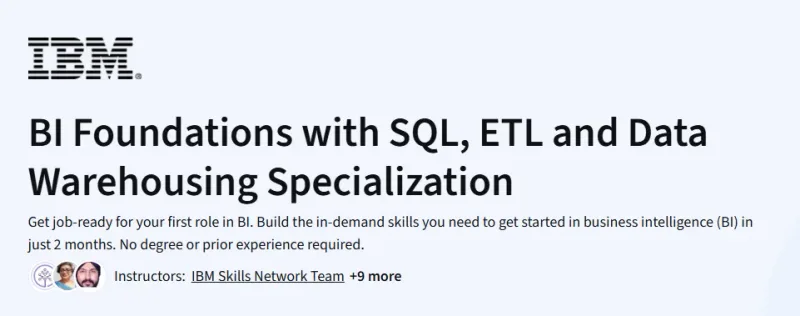
What will you learn in BI Foundations with SQL, ETL and Data Warehousing Specialization Course
-
Master SQL for data extraction and transformation in business environments.
-
Understand the principles of Extract, Transform, Load (ETL) processes and tools.
-
Build and manage data warehouse systems using best practices.
-
Analyze business data to generate meaningful insights for decision-making.
Program Overview
Module 1: Introduction to Data Analytics and Business Intelligence
⏱️ 2 weeks
-
Topics: Overview of BI, analytics lifecycle, KPIs, BI tools
-
Hands-on: Case-based analysis of BI applications in real businesses
Module 2: Getting Started with SQL for Data Analysis
⏱️ 3 weeks
-
Topics: SELECT statements, filtering, joins, aggregations
-
Hands-on: Querying real datasets using SQL on cloud platforms
Module 3: ETL and Data Pipelines with Shell, Airflow, and Kafka
⏱️ 3 weeks
-
Topics: Scripting basics, ETL concepts, task scheduling with Airflow, data stream with Kafka
-
Hands-on: Build a working ETL pipeline and deploy automated data workflows
Module 4: Data Warehousing and BI Analytics
⏱️ 3 weeks
-
Topics: Star and snowflake schemas, OLAP, data marts, data governance
-
Hands-on: Design and populate a mini data warehouse and run analytics
Get certificate
Job Outlook
-
High demand for BI Analysts and Data Engineers skilled in SQL and data warehousing.
-
Business Intelligence market is projected to grow at 8–10% CAGR through 2030.
-
Roles pay $70,000–$120,000 annually depending on specialization and experience.
-
Valuable for roles like BI Developer, Data Warehouse Analyst, or ETL Developer.
Explore More Learning Paths
Take your engineering and management expertise to the next level with these hand-picked programs designed to expand your skills and boost your leadership potential.
Related Courses
-
Google Business Intelligence Professional Certificate Course – Build industry-ready BI skills with Google’s structured training in dashboards, data modeling, visualization, and analytics workflows.
-
Generative AI for Business Intelligence (BI) Analysts Specialization Course – Learn how to leverage generative AI to automate insights, enhance data storytelling, and accelerate BI-driven decision-making.
-
Foundations of Business Intelligence Course – Understand the core principles of BI, from metrics and KPIs to reporting, dashboards, and data-informed business strategies.
Related Reading
Gain deeper insight into how project management drives real-world success:
-
What Is Project Management? – Understand the principles that make every great project a success story.