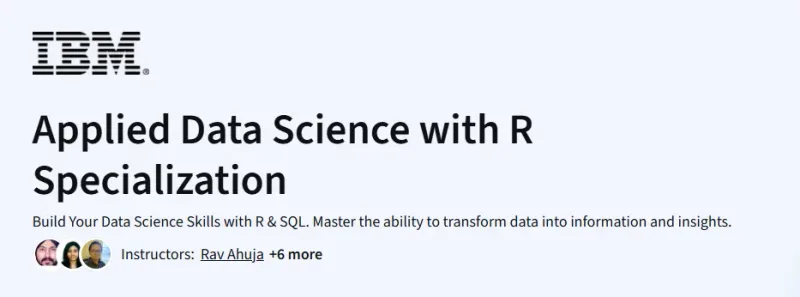
Applied Data Science with R Specialization Course

Applied Data Science with R Specialization Course Course

This specialization delivers a comprehensive, hands-on pathway for aspiring data scientists looking to specialize in R. It starts from scratch and builds toward a project-driven capstone, making it id...

Explore This Course
9.8/10 Highly Recommended

Applied Data Science with R Specialization Course on Coursera — This specialization delivers a comprehensive, hands-on pathway for aspiring data scientists looking to specialize in R. It starts from scratch and builds toward a project-driven capstone, making it ideal for learners who prefer a structured, applied approach.

Pros

  • World-renowned instructor with decades of teaching experience
  • Hands-on Octave/MATLAB assignments that deepen conceptual understanding
  • Comprehensive coverage from linear models to neural networks and clustering

Cons

  • Uses Octave/MATLAB rather than Python, requiring additional translation for Python practitioners
  • No coverage of deep learning frameworks like TensorFlow or PyTorch

Applied Data Science with R Specialization Course Course

Platform: Coursera

What will you learn in Applied Data Science with R Specialization Course

  • Build foundational knowledge in R programming tailored for data science tasks.

  • Perform statistical data analysis, data wrangling, and visualization in R.

​​​​​​​​​​

  • Work with real-world data using tidyverse packages and advanced visualization libraries.

  • Build machine learning models and understand data modeling pipelines in R.

Program Overview

Course 1: Introduction to R Programming

⏱️ 2 weeks

  • Topics: R syntax, data types, functions, conditionals

  • Hands-on: Write R scripts, use control structures, manage packages

Course 2: Data Wrangling with R

⏱️ 3 weeks

  • Topics: Data manipulation with dplyr, tidyr, and data cleaning

  • Hands-on: Load, clean, transform datasets using tidyverse

Course 3: Data Visualization in R

⏱️ 3 weeks

  • Topics: Visualizing with ggplot2, plot customization

  • Hands-on: Create bar plots, histograms, scatterplots, and advanced graphics

Course 4: Machine Learning with R

⏱️ 4 weeks

  • Topics: Supervised and unsupervised learning, model evaluation

  • Hands-on: Build decision trees, random forests, and clustering models

Course 5: Data Science Capstone Project with R

⏱️ 3 weeks

  • Topics: End-to-end project using real datasets

  • Hands-on: Apply R skills to analyze, model, and visualize data

Get certificate

Job Outlook

  • R is in high demand for roles such as Data Analyst, Statistician, and Research Scientist.

  • Ideal for candidates entering roles in academia, healthcare, finance, and policy research.

  • Median salary ranges from $65K–$115K depending on role and experience.

  • R remains a top skill for statistical analysis and data visualization tasks.

Explore More Learning Paths

Expand your R-based data science capabilities with complementary courses designed to strengthen your analytical thinking, enhance your workflow, and prepare you for more advanced or leadership-oriented roles in data.

Related Courses

1. Tools for Data Science Course
Build confidence with essential tools like Jupyter, GitHub, and RStudio to streamline your data analysis and prepare for real-world projects.

2. Data Science Methodology Course
Discover the structured process used by experts to define business problems, plan analytical approaches, and deliver impactful data solutions.

3. Executive Data Science Specialization Course
Develop leadership skills that help you manage data teams, oversee analytics projects, and guide data-driven decision-making across organizations.

Related Reading

What Is a Data Scientist?
A clear, beginner-friendly breakdown of the role, skills, tools, and career path of data scientists—perfect for learners building expertise in R.
FAQs

How much time should I dedicate weekly to complete the specialization effectively?
Estimated completion is around 4–6 months at a part-time pace. Weekly commitment of 4–6 hours is generally sufficient for lectures and exercises. Regular practice in coding, visualization, and modeling reinforces learning. Revisiting assignments or exploring additional datasets may require extra time. Consistent engagement ensures learners develop both conceptual understanding and practical R skills.
How relevant are the tools and skills taught for industry use?
R is widely used for statistical analysis, visualization, and reporting in many industries. Skills in data wrangling, visualization, and modeling are transferable to other analytics platforms. Applied exercises simulate workflows common in enterprise environments. Understanding R fundamentals makes it easier to learn additional data science tools later. Mastery of these skills enhances employability for analytics or research roles.
Can this course help me pursue a career in data science or analytics?
Provides foundational skills in data analysis, visualization, and statistical modeling using R. Learners gain practical experience applicable to data analyst or junior data scientist positions. Completion can strengthen resumes and portfolios for job applications. Additional learning in machine learning or big data may complement the course. Projects demonstrate applied problem-solving abilities to potential employers.
Will I gain practical experience analyzing real-world datasets?
The course uses real-world datasets to practice data cleaning, visualization, and modeling. Learners perform statistical analyses and exploratory data analysis (EDA) in R. Projects simulate scenarios similar to those in professional data science roles. Guided labs reinforce concepts through practical application. Hands-on work helps learners build a portfolio to demonstrate their skills.
Do I need prior experience with R or programming to start this course?
No prior R programming experience is required; the course introduces R from scratch. Basic familiarity with computers and data concepts is helpful but not mandatory. Exercises guide learners step-by-step through coding and analysis tasks. Supplemental tutorials can accelerate understanding for complete beginners. Hands-on projects help build confidence as learners progress.

Similar Courses

Other courses in Computer Science Courses