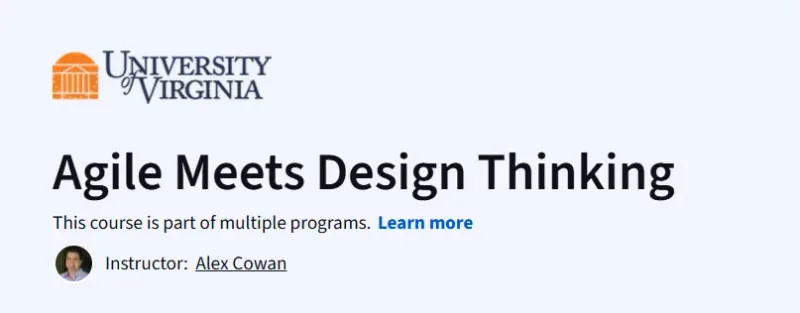
What will you learn in Agile Meets Design Thinking Course
-
Understand the fundamentals of Agile thinking and why Agile emerged in modern organizations.
-
Learn core Agile values and principles from the Agile Manifesto.
-
Differentiate Agile from traditional, plan-driven approaches like Waterfall.
-
Understand how Agile improves adaptability, collaboration, and customer focus.
-
Learn basic Agile roles, rituals, and workflows at a conceptual level.
-
Build a strong foundation for deeper study of Scrum, Kanban, and Agile project management.
Program Overview
Introduction to Agile Thinking
⏳ 1–2 weeks
-
Learn what Agile is and what it is not.
-
Understand uncertainty, change, and complexity in modern work environments.
-
Explore why traditional management approaches often fail in dynamic settings.
Agile Values and Principles
⏳ 1–2 weeks
-
Deep dive into the Agile Manifesto and its core values.
-
Understand principles such as customer collaboration, iterative delivery, and continuous feedback.
-
Learn how mindset shifts drive Agile success more than tools or processes.
Agile vs Traditional Approaches
⏳ 1–2 weeks
-
Compare Agile with Waterfall and other linear methodologies.
-
Understand trade-offs between predictability and flexibility.
-
Analyze real-world scenarios where Agile provides better outcomes.
Agile in Practice: Roles and Ways of Working
⏳ 1–2 weeks
-
Get introduced to common Agile roles and team structures.
-
Learn about iterations, feedback loops, and incremental delivery.
-
Understand how Agile principles apply beyond software teams.
Get certificate
Job Outlook
-
Agile knowledge is valuable across software, business, operations, and product teams.
-
Suitable for roles such as Business Analyst, Project Coordinator, Product Owner (Entry-Level), and Team Lead.
-
Helps professionals collaborate effectively in Agile and hybrid work environments.
-
Provides a strong foundation for advanced Agile, Scrum, and project management certifications.