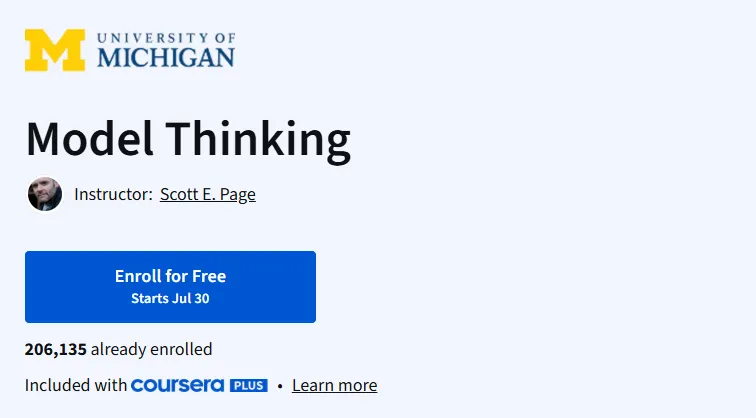
What will you learn in Model Thinking Course
-
Understand the importance of models in interpreting and shaping the world.
-
Apply various types of models—decision, growth, social network, and contagion models—to real-world scenarios.
-
Think systematically using models to improve predictions and decisions.
-
Recognize the strengths and limitations of different models in complex environments.
Program Overview
Module 1: Why Model?
⏱️ 1 week
-
Topics: Purpose of modeling, cognitive limitations, value of multiple models.
-
Hands-on: Introduction to conceptual modeling through basic real-world examples.
Module 2: Types of Models
⏱️ 2 weeks
-
Topics: Decision models, tipping points, linear vs. nonlinear thinking.
-
Hands-on: Analyze examples like Schelling’s segregation model and simple voting models.
Module 3: Predictive & Social Models
⏱️ 2 weeks
-
Topics: Forecasting, diffusion models, feedback loops, network theory.
-
Hands-on: Simulate social networks and diffusion of innovation.
Module 4: Growth and Aggregation
⏱️ 2 weeks
-
Topics: Exponential vs. logistic growth, random walks, aggregation mechanisms.
-
Hands-on: Interpret population dynamics and economic trends using models.
Module 5: Complex Systems & Model Ensembles
⏱️ 2 weeks
-
Topics: Diversity of models, combining models, wisdom of crowds.
-
Hands-on: Evaluate complex systems like cities, markets, and ecosystems using layered modeling.
Get certificate
Job Outlook
-
High value across data science, public policy, economics, finance, and social sciences.
-
Enhances critical thinking for analysts, policymakers, researchers, and decision-makers.
-
Salary potential: Analysts or modelers can earn $60,000–$120,000 depending on industry and experience.
-
Strong foundation for roles involving forecasting, systems analysis, and simulations.
Explore More Learning Paths
Enhance your analytical thinking and problem-solving skills with these carefully selected programs designed to strengthen your reasoning, decision-making, and data-driven mindset.
Related Courses
-
Critical Thinking Skills for University Success Course – Build a strong foundation in academic reasoning, argument analysis, and intellectual discipline essential for higher-level problem-solving.
-
Mindware: Critical Thinking for the Information Age Course – Learn how to apply modern thinking tools to everyday decisions and avoid common reasoning errors in a data-rich world.
-
Introduction to Logic and Critical Thinking Specialization Course – Gain mastery over formal logic, structured reasoning, and analytical frameworks used across academic and professional fields.
Related Reading
Strengthen your understanding of how structured thinking supports better problem-solving and decision-making:
-
What Is Knowledge Management? – Learn how organizations capture, organize, and apply knowledge to enhance efficiency and make smarter decisions.